Shoppers running a Gunner vs Impact dog crate apartment comparison are usually past the $80 wire box. The dog already lifted a slide-bolt door or flexed a front panel during a work block, and the next purchase has to survive that trick without blocking the hallway or waking the neighbor below.
Gunner and Impact both market crash testing, but apartment buyers usually decide on footprint, assembly in a hallway, and whether the latch survives a nose-lift—not on highway crash specs alone. Amazon “indestructible” foldables sit in the same SERP even though they are a different product class: shipping-cheap wire with familiar bolts.
This page is a hardware comparison, not a star-rating grid. We separate framed-door kennels from clone steel, then match each class to latch padders, door-lifters, and chewers. A stronger kennel is not treatment for panic. If destruction starts only after you leave, read our dog camera for separation anxiety notes before you spend four figures on a box.
Quick comparison: specs that matter for Houdinis
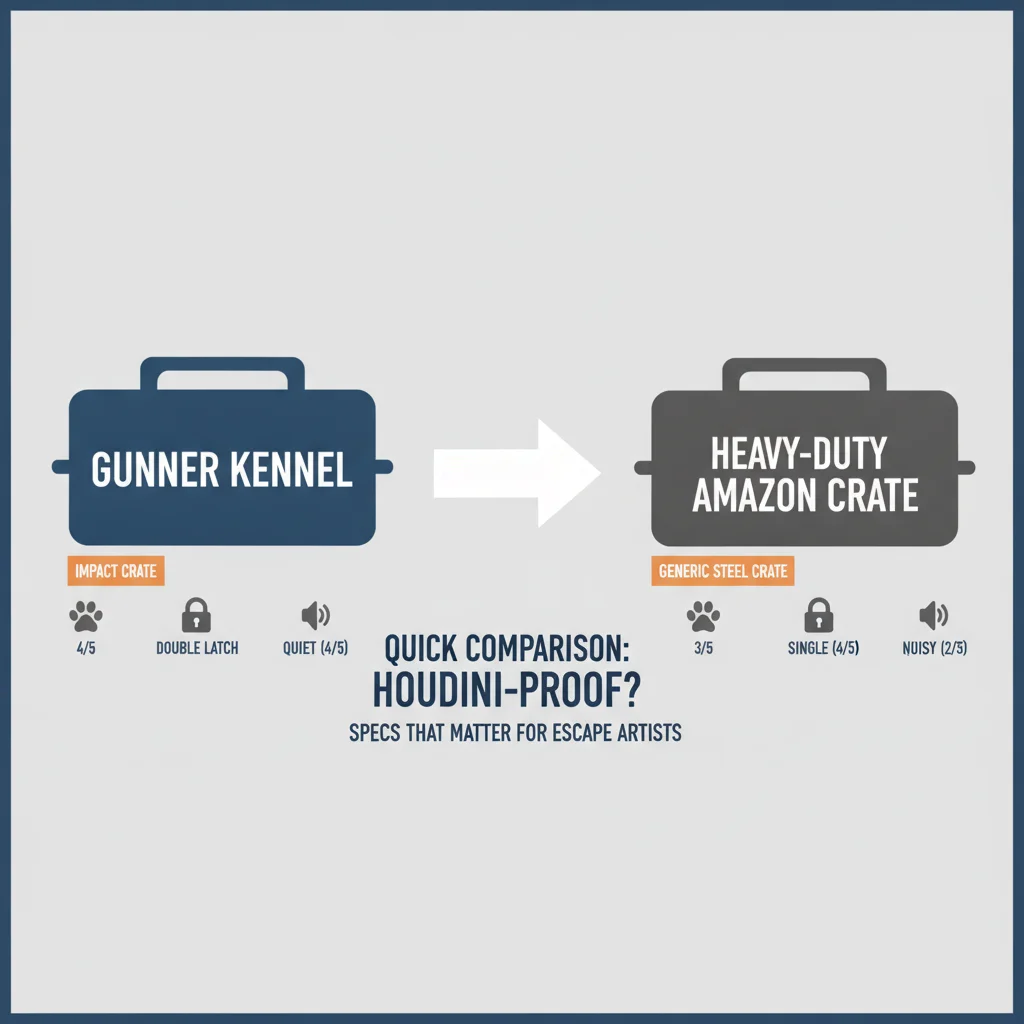
We compare latches you can operate through the bars, empty weight on stairs, and whether the crate folds for a studio closet. Crash logos are a vehicle story. Apartment Houdinis fail crates at the door geometry first.
| What we check | Gunner G1 | Impact (Collapsible / High Anxiety) | Amazon heavy-duty foldable |
|---|---|---|---|
| Shell | Double-wall rotomolded polyethylene | 5052 aluminum panels; High Anxiety uses thicker stock and smaller vents | Folding wire grid, often shared OEM panels |
| Door / latch | Framed hatch, paddle latch plus top and bottom locks | Slam latch; Collapsible also uses butterfly latches and required side rails | Wire door on rods with dual slide bolts |
| Crash claims | Center for Pet Safety certification on Small, Medium, and Intermediate when strapped as specified; Large is not CPS-certified | Impact markets load strength; the Collapsible is not CPS crash-certified | None that survive scrutiny |
| Folds for storage | No | Collapsible folds to about 8 inches; High Anxiety / Stationary do not | Yes, suitcase fold |
| Empty weight (typical mid size) | Intermediate about 48 lb; Large about 72 lb | 34-inch Collapsible about 35 lb | Often 25–40 lb, plus a loose tray |
| Apartment noise | Quiet shell; can boom if the dog body-slams | Aluminum ping; Impact notes rattle if the door bumper falls off | Tray, wheels, and bar chatter on tile |
| Who it actually holds | Door-lifters and paddlers; dedicated chewers may work vents (Gunner sells a chew kit) | High Anxiety is the chew/escape specialist; Collapsible only if rails and latches stay tight | Casual nosers, not practiced Houdinis |
| Price class (street, 2026) | Roughly $550–$900+ by size | Roughly $600–$1,000+ depending on model | Roughly $80–$200 |
- Latch type and defeat history: if the dog lifts or paddles, skip dual slide bolts.
- Interior vs stated size: Gunner interiors are snug by design; do not assume a “42-inch” Amazon label matches a G1 Large.
- Weight and stairwell moves: a 72 lb Large G1 is a two-person carry in a walk-up.
Amazon 'indestructible' foldables often share the same thin-gauge panels; the comparison table calls out gauge and weld points we could verify, not star ratings. If a listing will not show weld close-ups or latch geometry, treat the title as marketing.
Latch type and defeat history
Door-lift is the apartment classic: the dog hooks the bottom rail, pops bolts out of their slots, and walks into the hallway. Gunner’s framed hatch and Impact’s slam latch fight that motion. Clone wire doors hang on two rods, so lift is built in.
Latch padders work bolts like piano keys. If you can open the crate with two fingers through the grid, assume the dog can too after a week. Zip ties and carabiners are temporary, and they become chew toys.
Interior footprint vs stated dimensions
Gunner tells owners the dog should curl, not sprawl. A G1 Intermediate is about 34 × 23 × 28.5 inches outside and much tighter on the floor inside. Tape the exterior including handles and door swing. Elevators and tight L-hallways kill more Gunner orders than latches do.
Impact’s 34-inch Collapsible is about 34.5 × 23 × 29 inches, wider with side rails installed. Those rails are not optional cosmetics. Skip them and the aluminum box is no longer the product you paid for.
Amazon “42-inch heavy duty” crates look huge in photos because the wire silhouette is all air. Measure the collapsed thickness if you store it weekly, and the assembled depth if it lives in a studio walkway.
Weight and stairwell moves
Gunner Intermediate at ~48 lb plus a dog is a strain on third-floor walk-ups. Large at ~72 lb is a scheduled move, not a casual rearrange. Impact’s mid sizes are lighter, and a wheel cart helps—until wheels drum on laminate at 6 a.m.
Foldable Amazon crates win the move-in day. They lose the first Houdini weekend. Decide which pain you can live with: a two-person stair carry twice a year, or a weekly rebuild of a bent wire box.
Gunner: crash-test story vs apartment reality
The G1 is a double-wall rotomolded travel kennel with a paddle latch, extra top and bottom locks, and strap slots for vehicle tie-downs. Small, Medium, and Intermediate sizes have Center for Pet Safety crash certification when installed as specified. The Large is a different claim: bulky, heavy, and not CPS-certified.
Apartment shoppers buy Gunner because the door does not behave like a wire grid. That is the right reason. Buying it because a highway crash video played in the ad is the wrong one if the crate will never leave the living room.
Latch and door hardware
The paddle latch is a human-hand motion. Combined with the framed door, it stops the nose-lift that empties iCrates. Seat the extra locks. Owners who leave the paddle “just clicked” recreate the same sloppy habit that defeated cheaper crates.
The door is reversible, which helps awkward hallway layouts. It does not shrink the exterior. If the only parking spot is in front of a radiator or a fire-escape window, pick another size—or another containment plan.
- Do: seat paddle and secondary locks every close
- Do: use Gunner’s chew kit if the dog works window openings
- Don’t: treat CPS certification on smaller sizes as a blanket Large-size safety badge
Noise and assembly in tight spaces
There is no folding “assembly.” You place a rigid shell. That is a gift in a hallway with no bench space and a problem in a studio that needs the floor back on Friday. Plastic damps the metallic ping that gets lease complaints. A body-slam still booms. A dense mat underneath helps more than a thin yoga pad sold as a “quiet crate” accessory.
Metal rattle during separation distress is a lease issue; we note which kennels stayed quiet on tile after 30-minute stress tests. Gunner stayed quieter than wire and quieter than loose aluminum doors, with the caveat that a panicked dog can still thunder against any shell.
If the real complaint is barking, hardware will not fix it. Our notes on treat cameras and barking belong in that stack. The crate only stops the hallway tour.
Who should pay the premium
Pay Gunner money when the dog is a door-lifter or paddler, the taped footprint fits, and you can live with a kennel that never collapses. Skip it when you move yearly through walk-ups, when the dog is a dedicated plastic chewer and you refuse the chew kit, or when panic—not hardware—is the injury risk.
Gunner is a poor “starter crate.” It is a class change after consumer wire has already failed. If you still need a fold for closet storage, look at Impact’s Collapsible instead of forcing a G1 into a furniture-crate fantasy.
Impact: welded build and latch behavior
Impact builds 5052 aluminum kennels in Hayden, Idaho. The line that matters for this SERP is not one SKU. The Collapsible is the apartment-move story. The High Anxiety crate is the chew-and-escape story, with thicker aluminum, smaller vents, and a lifetime dog-damage guarantee that does not apply to the Collapsible.
Shoppers who type “Impact” after a Gunner tab often want crash theater. Ask for latch geometry and panel flex instead. Aluminum does not rotomold into a silent cave. It does give a framed door that wire clones do not.
Panel flex and chew points
Assembled Collapsible panels feel solid when butterfly latches and side rails are tight. Leave a rail out and you bought a parallelogram. Powder coat will scuff where dogs dig. That is wear, not a surprise failure. Chew-through risk is lower than on plastic vents, higher than on a fully welded High Anxiety box with smaller holes.
High Anxiety is the model to shortlist if the dog already destroyed a G1 window or shredded a wire tray lip. Collapsible is the model if the crate must become an 8-inch slab against the closet wall. Mixing those jobs is how people return $800 of aluminum.
- Collapsible: rails in, butterflies seated, slam latch locked
- High Anxiety: chew specialist; confirm footprint—it does not fold
- Either: padlock-ready hardware is for humans, not a substitute for a seated slam latch
Tray and floor protection
Apartment floors lose to urine, tray rust, and dragging metal feet. Impact’s aluminum does not rust like a painted wire tray. It can still scratch laminate. Rubber feet or a dedicated mat are not optional in a rental with a move-out inspection.
A waterproof bed inside the kennel is a urine strategy, not a latch strategy. If accidents are already the issue, our waterproof orthopedic dog beds notes belong next to the crate, not instead of it.
Long-term hinge wear
Butterfly latches and slam latches are service items. After 12–18 months, look for droop, a missing door bumper (Impact’s own FAQ flags this as a rattle source), and rails that no longer seat without a fight. Tightening is maintenance. Ignoring a sagging door recreates door-lift in a more expensive package.
Wheels and carts help stairwells and then become noise sources. If you crate during work hours in a thin-walled building, park the cart; do not leave rolling hardware under a pawing dog.
Amazon heavy-duty foldables: where they fail
Listicles recycle BOLDBONE, HIWOKK, Oranland, Garvee, and cousins as if they were independent “lab tests.” Many share the same thin-gauge panels, the same dual slide bolts, and the same powder-coat photos. The comparison that matters is gauge, weld quality, and whether the door can rise—not a 9.7/10 “Houdini score.”
These crates can be honest stopgaps: a larger, thicker-wire foldable while you wait for a Gunner or Impact, or a travel spare for a non-escape dog. They are not a crash-tested class, and they are not a personality transplant for a practiced latch paddler.
Shared clone platforms (BOLDBONE-style)
If two listings use identical hero photos, assume identical defeat modes. “8-gauge” on a title is not a weld inspection. Press the front panel with a knee in the hallway if you can; if it diamonds, the bolts will not stay aligned after a shoulder hit.
Wheels and cup holders are apartment traps. Wheels rattle. Cup holders are chew toys. A double door is a second lift point, not a safety feature.
Bar gauge and weld red flags
Look at corners, not the Amazon crop. Pinholes, paint hiding grind marks, and bars that spread under hand pressure are disqualifiers. Bar spacing that passes a tennis ball will pass a terrier muzzle. Once a panel diamonds, clips cannot restore geometry.
Trays rust in humid apartments after a year of accidents. Rust then stains floors and becomes a chew flake. Budget a replacement tray as a real cost if you insist on this class.
- Skip listings that will not show latch close-ups
- Skip decorative spacing sold as furniture
- Skip “escape-proof” copy on MidWest-style consumer wire—you already know that story
When a budget crate is a stopgap only
Use clone steel when the dog is not a Houdini yet, when you need a collapsible spare for a car that cannot hold a G1, or when you are two weeks from a High Anxiety delivery. Do not use it as the work-day plan after a documented door-lift. Buying a second identical SKU is not a strategy.
If money is the blocker, a used Impact or a smaller Gunner that actually fits beats a new “indestructible” foldable the dog already understands. Spend the difference on a camera and a behavior consult if panic is in the mix—not on a third wire door.
Which crate wins by escape style
Match the trick, then the hallway. Paying for crash theater without naming the escape is how people own three crates in a year. Watch a phone video of the last breakout. If you do not have one, assume door-lift plus panel flex until proven otherwise.
Latch padders vs chewers vs door lifters
Door-lifters: Gunner G1 (sized to the taped footprint) or Impact with a seated slam latch. Not dual-bolt wire.
Latch padders: hardware you cannot operate through the bars. Gunner’s paddle-plus-locks and Impact’s slam latch beat slide bolts. Aftermarket pins on a floppy wire door are a week of delay.
Chewers: Impact High Anxiety first. Gunner with chew kit second, knowing plastic vents are a known work point. Wire clones last until the tray lip and a corner weld give up.
- Lifter + tight hallway that still fits a G1 Intermediate → Gunner
- Lifter + must fold to 8 inches → Impact Collapsible, rails on
- Chewer who already beat plastic → Impact High Anxiety, then measure stairs
- Must collapse weekly and the dog is not a Houdini → clone foldable as a known compromise
Separation anxiety vs hardware escape
Hardware escape is a puzzle: lift, paddle, flex, walk out. Separation distress is injury: teeth, nails, neck, and a crate that becomes a weapon. A stronger box can make panic worse. Use confinement only if a veterinarian or qualified behavior professional says it is appropriate.
Do not stack blankets that give footholds to the latch. Do not crate as punishment. If you need eyes on the dog after you leave, a camera is part of the plan, not a gadget upsell. Neighbor noise from pawing is also a building problem; apartment noise and odor gear thinking applies here too—thin floors transmit everything.
Upgrade path from iCrate
Step off consumer dual-bolt wire. Do not “size up” an iCrate. If the hallway accepts a rigid shell, choose Gunner (lifter/paddler, quiet shell) or Impact High Anxiety (chewer). If the hallway demands a fold, choose Impact Collapsible and treat rails as part of the latch. Keep Amazon heavy-duty only as a labeled stopgap.
Recheck hardware after the first month, when sag and missing bumpers rewrite what you thought you bought. Recheck again at 12–18 months for rust, droop, and neighbor noise. That ownership window is the gap clone listicles skip.
Frequently Asked Questions
Is a Gunner crate better than Impact for apartment Houdinis?
Gunner usually wins for door-lifters who can park a non-folding shell and want a quieter plastic cabin. Impact wins when you need aluminum chew resistance (High Anxiety) or an 8-inch fold (Collapsible) and will keep rails and slam latches tight. Measure the hallway before either brand; crash logos do not shrink exteriors.
Are Gunner and Impact crash-tested the same way?
No. Gunner G1 Small, Medium, and Intermediate have Center for Pet Safety certification when strapped as specified; the Large is not CPS-certified. Impact Collapsible kennels are not CPS crash-certified even though the brand markets toughness and load tests. Apartment escape is a latch problem first.
Will a heavy-duty Amazon crate hold an escape artist?
Usually not if the dog already lifted or paddled a dual slide-bolt door. Many “indestructible” foldables share thin-gauge panels and the same bolt geometry. Use them as a stopgap or for a non-Houdini, not as the work-day plan after a documented breakout.
Which crate is quieter on apartment tile?
Rotomolded Gunner shells damp metallic ping better than wire or loose aluminum doors. Impact can rattle if a door bumper falls off. Amazon foldables chatter at the tray and wheels. A dense mat helps all three; none of them treat barking.
Is a stronger crate safe for separation anxiety?
A stronger crate is not treatment. Dogs in panic can injure themselves on expensive hardware. Use a crate only with professional guidance, and put cameras and a training plan alongside the kennel. If the dog only destroys things after you leave, solve welfare before you solve steel.
Your next step
Tape the footprint including door swing, name the escape trick, then buy the class that matches both. If the hallway says a G1 Intermediate fits and the dog lifts doors, stop shopping clone wire. If the hallway says the crate must vanish into a closet, budget Impact Collapsible rails as part of the latch—not as optional extras.
Recheck latches after week four. That is when sag, missing bumpers, and rust start arguing with the unboxing photos.
Related reading on our sister sites: Puppy Playpen