If your dog keeps opening crate latch hardware on a consumer wire box, you are not shopping for a prettier crate. The dog already learned the puzzle: lift the door, paddle the bolts, or flex the front panel until the “double latch” is theater.
This is a failure-mode guide for apartment Houdinis—latch padders, door-lifters, and panel-racking dogs—not crate-training 101. A stronger kennel is not treatment for panic. If the destruction only starts after you leave, get behavior help before you spend four figures on steel.
Apartment Houdinis usually defeat latches in one of four ways—paddle, lift, rack, or spread bars—not because they are smarter than the bolt marketing. Match the trick to the hardware, then decide whether a clip buys you a week or you need a different product class.
Latch failure taxonomy: how apartment Houdinis actually win
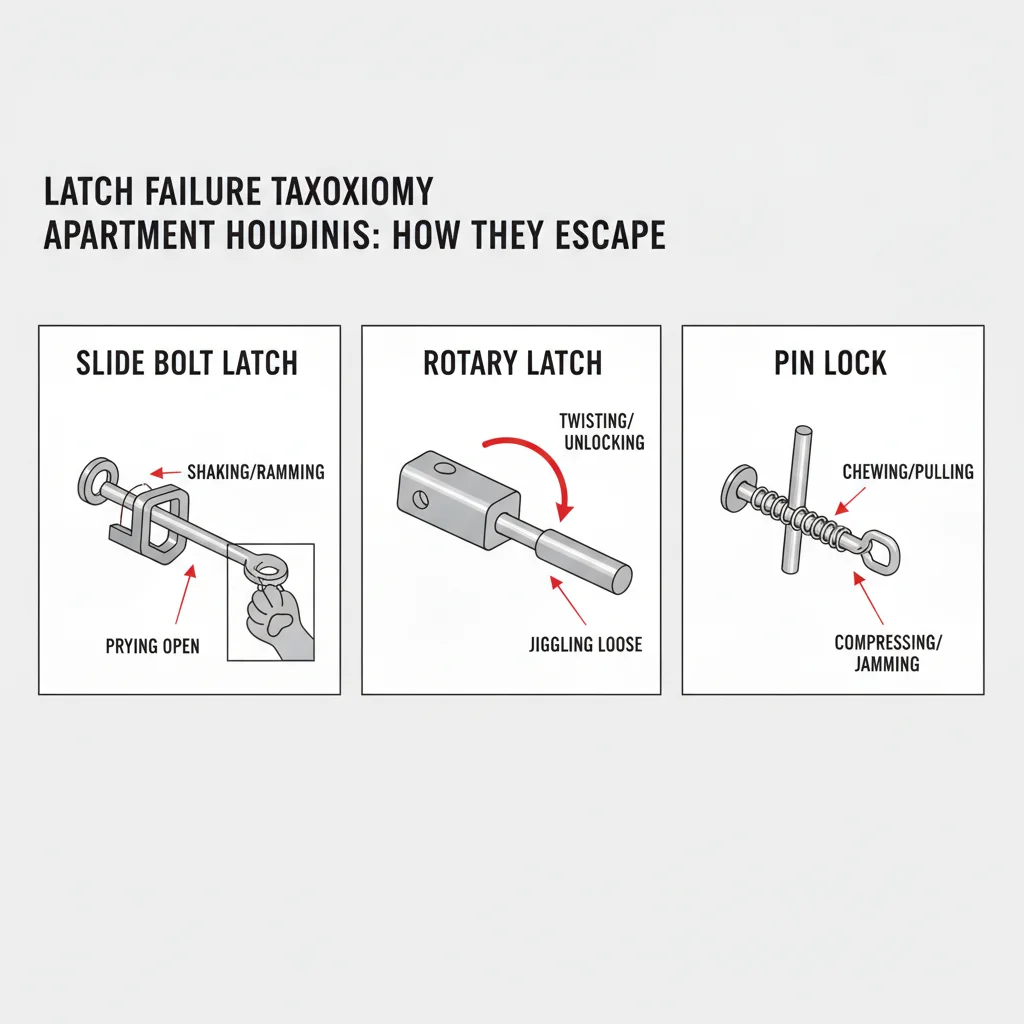
Clone listicles treat “double slide bolt” as a personality. It is a geometry. If you can open the crate with two fingers through the bars, assume the dog can after a week of practice—especially during the 6 a.m. shoe-and-keys ritual.
Film the next escape if you can. A 20-second hallway video is more useful than another Amazon review that says “heavy duty.” Name the trick before you buy clips, a latch kit, or a kennel that will not turn the corner past the recycling bins.
| Defeat mode | What you see | What actually fails | What holds it |
|---|---|---|---|
| Paddle / two-finger open | Nose or paw walks both bolts | Slide bolts you can reach through the grid | Pin-lock or rotary you cannot operate through bars |
| Door-lift | Bottom rail pops; bolts leave their slots | Wire door hanging on two rods | Framed hatch that cannot rise; seated pin |
| Rack / panel flex | Door diamonds; bolts “closed” but not seated | Thin-gauge front panel | Welded or crash-style frame that stays in plane |
| Bar spread / chew | Muzzle in a gap; corner crush | Clipped panels, wide bar spacing | Gauge and welds, not a louder clip |
Slide-bolt paddlers and two-finger opens
Most MidWest-style foldables use two sliding rods on a floppy wire door. Dogs learn the sequence: bump the lower bolt, walk the upper bolt, wait for the hallway. A second bolt is not a lock if both share one flexible door.
Padders work the hardware like piano keys. If the bolts have rounded ends and a short throw, a nose is enough. Aftermarket levers sometimes make this worse by giving a bigger paddle.
- Test: can you open both bolts with two fingers through the bars?
- Test: do the bolts fully seat when the door is slightly racked?
- Skip: “security” clips that the dog can still rake from inside
If the dog only succeeds when you forget to seat a bolt, that is a habit problem. If the dog succeeds with both bolts seated, that is a product-class problem. Do not mix those up on the next Amazon order.
Door-lift and bottom-rail escapes
Door-lift is the apartment classic. The dog hooks the bottom rail, pops the door up, and the bolts slide out of their keepers. Dual bolts do nothing if the door can rise.
Crash-style kennels fight this with a framed hatch that seats into a channel. Pin-lock kits fight it by tying the door to the frame at a height the dog cannot lift in one motion. Carabiners through bolt holes only help if they take load when the door is lifted—not when they dangle as jewelry.
Watch the bottom corners. A tray that sits proud of the frame gives a toe-hold. A blanket bunched at the door gives a foothold. Hardware plus messy bedding is a ladder.
Panel flex that racks the bolts
Escape artists do not only open doors. They hit the front panel with a shoulder until it diamonds. Once the panel is out of plane, the bolts look closed from the kitchen and are already clear of the keepers.
Press the front with a knee. If it bows, the latch will rack under a 40-pound hit. Thin-gauge “heavy duty” foldables fail this test while looking thicker in photos.
- Knee-press the front and the latch side, not the Amazon hero angle
- Look for welds at corners, not zip-tied panels pretending to be a frame
- Retire a door that already diamonds—clips will not un-bend geometry
A zip tie on a slide bolt is a band-aid; if the front panel flexes, every latch geometry fails the same weekend. Stop buying accessories for a door that has already left its plane.
Quick fixes that sometimes buy you a week
Hacks are for travel days, a guest weekend, or the 48 hours before a kennel arrives. They are not a 12-month apartment plan. Treat them as emergency stops, then schedule the upgrade.
If the dog is blooding a muzzle on bars while you “just add one more clip,” stop. That is injury risk, not DIY.
Clips, carabiners, and zip ties—limits
Carabiners through bolt holes can slow a paddler for a few days. They do not fix door-lift if the clip is on a rod that still rises. They also become chew toys and neighbor-clank sources in thin-walled buildings.
Zip ties fail to teeth and UV. Cable that the dog can reach from inside is a GI-foreign-body risk, not a lock. C-clamps on the frame can buy a week and will scratch laminate.
- Do: one load-bearing clip that actually stops lift, checked after each outing
- Don’t: a cluster of ties that rattle at 6 a.m. and look like a storage unit
- Don’t: leave a clip on a bent door and call the crate rebuilt
If you need clips every workday, you already know the crate lost. Budget the next class instead of a hardware-aisle hobby.
Alignment shims and tray noise
Neighbor noise from latch rattling at 6 a.m. is a sign the door is already out of alignment—fix alignment before you buy a louder carabiner. A sagging tray, a bent bottom rail, or a crate sitting on a rug lump will keep the bolts from seating.
Set the crate on a level, dense mat. Seat the tray fully. Close the door with the crate empty and watch whether both bolts drop without you lifting the door by hand. If you have to lift, the dog has to lift too—and the dog is better at it.
Rubber feet help ping on tile. They do not quiet a loose tray drumming in a metal pan. A folded towel under the tray can help; a pile of bedding against the door can give a lift step. Pick the quieter failure.
When a hack voids warranty or hurts teeth
Drilling extra holes in a crash kennel, grinding a latch, or forcing a pin kit onto a door it was not designed for can void coverage and create bite points. If you keep a branded kennel, use the manufacturer’s latch kit or a documented aftermarket made for that door.
Never add a lock the dog can catch a canine on. Never leave a bungee inside the crate. Never use a padlock on a panic dog—you need a human-speed open in an emergency.
If the hack requires tools every morning, it is not a fix. It is a ritual that teaches the dog the crate is a puzzle you are still solving.
Upgrade when the defeat is structural (flex, lift, chew-through) rather than “forgot to latch.” Daily Houdinis need a different product class, not a louder clip.
Hardware upgrades by defeat mode
Match the crate to the trick. Padders need hardware you cannot operate through the bars. Lifters need a door that cannot rise. Flexers need a frame that stays square. Buying “more steel” without naming the trick is how people own three crates in a year.
Our escape-proof apartment crate shortlist groups product classes by those tricks. Use this page to diagnose; use that page to shop.
Pin-lock and rotary replacements
Pin-lock gates (a pin you drop or twist through aligned holes) stop casual padders. Rotary latches on crash kennels need a human hand angle the dog does not have. Neither is magic if you leave the pin out while you carry groceries.
Aftermarket crate latches exist. Some are excellent on a still-square door. Some add a lever the dog can rake. If you keep a foldable crate, budget a latch upgrade as a real line item, then re-test with the door under load—not with the crate empty on the kitchen island.
- Install, then knee-press the door and try the old two-finger open
- Confirm the pin cannot be lifted with a nose from the usual paddle height
- Replace, do not stack, if the door already diamonds
Reinforced doors on welded kennels
Welded kennels win when the door seats into a channel and the front cannot diamond. Look for continuous welds, not a thick-wire foldable with the same two-rod door the dog already beat. Thickness without geometry is a heavier toy.
Some “heavy duty” Amazon foldables use thicker wire and still keep the same defeatable latch. Read the door, not the title. If the silhouette is a consumer wire crate, assume consumer latch physics.
For a side-by-side of framed-door kennels versus clone steel, use the Gunner vs Impact vs Amazon hardware comparison. That page is the shopping argument; this page is why your current bolts lost.
When Impact High Anxiety beats a foldable
Impact-style aluminum and High Anxiety builds are for dogs that body-slam, chew vents, and work a latch for the full workday. They are not hallway-easy. They win when door-lift and panel flex already retired two wire crates.
Gunner-style rotomolded kennels win on door-lift and rattle damping. They lose if you cannot park the footprint or carry the empty weight down three flights. Foldables still win a studio closet on Friday—and still lose Sunday if the dog is a Houdini.
There is no SKU that is both elevator-easy and truly Houdini-proof. Pay for the constraint you cannot cheat. Renters who move yearly should not buy a kennel they cannot get down the stairwell without hiring help.
Crates to retire—not patch
Disqualifying popular crates is the useful part of this niche. Authority roundups still point anxious owners at products that fail the first determined dog. Skipping them is the job, not a brand grudge.
If relatives keep gifting “cute” crates, screenshot this section. The dog does not care about the living-room aesthetic once the latch is a toy.
Midwest iCrate and thin wire
MidWest iCrate-style foldables are fine for travel, house-training a non-Houdini, or a sedate recovery dog. They are not escape-proof. Double-door, double-latch marketing taught a generation of shoppers the wrong lesson.
If your dog already left one, do not buy a second in a larger size and expect a personality change. Size rarely fixes latch defeats. A larger thin-wire crate gives more flex and bar-spread leverage.
Thin-gauge “training crates” from big-box aisles fail faster. The paint looks friendly. The door rods do not.
Furniture and soft crates
Soft crates are luggage. Zippers are not locks. Furniture crates with decorative slats give chew purchase and a lift point. Both show up in apartment mood boards because they hide the “I own a kennel” look.
Hide it after the dog cannot leave, not before. A side-table crate that the dog dismantles at 2 p.m. is a lease problem and a welfare problem, not a Pinterest win.
- Soft crate: overnight travel for a dog that does not unzip suitcases
- Furniture crate: display only, or a truly crate-neutral adult dog
- Neither: work-day containment for a documented Houdini
Amazon clone heavy-duty with same bolt geometry
Many listings copy the same “indestructible” photos and invented scores. The steel can still flex, the tray rusts, and the latch is often a slide bolt the dog already beat. Buy one only if you verified bar gauge, weld quality, and a latch style that matches how your dog escapes—not because the title says Houdini.
Shared OEM panels show up across brand names. If the door hangs on two rods with dual slides, you already know the failure. Paying $40 more for black powder coat does not change physics.
Wheels add hallway drum. If you need wheels to move a “heavy duty” foldable every night, you also need to hear that rattle through the floor below. Park it, pad it, or pick a quieter shell.
Separation anxiety vs escape artist
These are different problems that share a hallway. An escape artist defeats hardware and then settles. A panic dog may injure teeth, nails, and neck on bars even in an expensive kennel. Selling the second dog a stronger latch is how people get ER bills.
If destruction only happens after departures, talk to a veterinarian or qualified behavior professional before buying stronger steel. A crate is not an anxiety treatment.
When a stronger latch makes injuries worse
A crate that finally holds a panic dog can trap the panic. Bloody paws, broken teeth, and soaked bedding after you leave are stop signs, not proof you needed a pin-lock. Stop the confinement experiment and get help.
Never padlock a distressed dog in. You need to open the door fast if something goes wrong. Hardware that a human cannot open quickly is the wrong hardware for a welfare case.
- Escape artist: calm or opportunistic once out; hardware failed
- Panic: ongoing thrash, vocalizing, self-injury, wrecked nails
- Mixed: get the behavior plan first; hardware second
Cameras and training before steel
A cheap camera tells you which problem you have in the first 20 minutes. If the dog paddles the latch, then lies down, you have a Houdini. If the dog never stops, you have a welfare problem that a Gunner will not fix.
Training plans, departure cues, and (when a professional says so) medication sit alongside hardware. Do not skip that stack because a crash-kennel ad is persuasive. The crate’s job is safe containment when containment is appropriate—not to replace a behavior plan.
Crate the dog before you pick up keys if anticipation paddling is the trigger. That habit costs nothing and slows the puzzle. It still will not save a floppy door.
Safe containment alternatives in small homes
If a closed box is unsafe, do not solve panic with a smaller, stronger cage. Talk through gated rooms, daytime sitters, or a dog-walk schedule that does not rely on a Houdini crate. Exercise pens are not the substitute: climbers treat them as jungle gyms.
A bathroom with a baby gate is not “escape-proof.” It can be a supervised zone. Apartment Houdinis that open crate latches also open lever handles. Door hardware is a separate shopping trip.
If HOA or lease rules limit kennels in common areas, measure anyway. A legal crate that the dog leaves is not compliance; it is a hallway incident waiting for a neighbor’s complaint.
Apartment checklist before you spend again
Tape the footprint. Name the trick. Then buy in the class that matches both. If the hallway says foldable, upgrade the latch and accept that you are managing risk, not buying a myth. If the hallway says a crash kennel fits, stop shopping clone wire.
Recheck latches after the first month, when sag and rust start rewriting the hardware you thought you bought. 12–18 month apartment wear is the real test, not unboxing day.
Measure footprint and door swing
Tape width, depth, and the door arc on the floor. Leave a night path to the bathroom. If the only spot is in front of a radiator or a fire-escape window, pick a different size—or a different containment plan.
Measure the elevator interior and the stairwell turn. Rigid kennels win strength and lose mobility. A two-person carry twice a year can beat a weekly rebuild of a bent wire box—if you can actually make the carry.
- Adult dog length plus a small turnaround—not a giant hallway blocker
- Door swing that does not hit the fridge or a radiator
- A path out in a fire drill that does not require disassembly
Noise on tile and hallway carry
Metal sings. Plastic shells damp ping and can still boom when a dog body-slams the side. Rubber feet and a dense mat help more than a $12 “quiet crate” pad that is a thin yoga mat.
If the complaint from next door is barking, a latch will not fix it. Hardware only stops the hallway tour. If the complaint is rattle, fix alignment and tray play before you add clips that clank.
Wheels help a move-in and drum on laminate at 6 a.m. If you crate during work hours in a thin-walled building, park the crate and kill the wheel rattle first.
Link to the buying guide and premium comparison
Diagnosis first, SKU second. When you know paddle vs lift vs flex, use the escape-proof apartment crate shortlist to pick a class that still fits a stairwell. When you are choosing framed-door kennels versus clone steel, use the Gunner vs Impact vs Amazon hardware page.
Do not buy a third consumer foldable “just to try a bigger one.” Upgrade latch class and gauge first. Size to adult length with a small turnaround—not a vault that blocks the hallway and still uses the same bolts.
Frequently Asked Questions
Why does my dog open the crate latch so easily?
Most consumer crates use slide bolts on a flexible wire door. Dogs lift the door, paddle both bolts with a nose, or flex the front panel until the bolts no longer seat. A second bolt does not help if the door can rack out of plane.
Will carabiners or zip ties make a crate escape-proof?
They can slow a paddler for a few days but they do not fix panel flex or door-lift geometry. They also become chew targets and rattle sources in thin-walled apartments. Treat them as emergency stops, not a long-term plan.
What latch type holds determined escape artists?
Pin-lock, rotary, and crash-kennel door geometry hold better than dual slide bolts on thin wire. Welded steel or rotomolded shells that prevent door-lift beat most Amazon heavy-duty foldables that reuse the same bolt layout.
Should I get a bigger crate if the dog escapes?
Size rarely fixes latch defeats. A larger thin-wire crate gives more flex and bar-spread leverage. Upgrade latch class and gauge first, then size to adult length with a small turnaround—not a giant box that blocks the hallway.
Is an escape artist the same as separation anxiety?
No. Escape artists defeat hardware when you leave; panic dogs may injure themselves even in expensive kennels. If destruction only happens after departures, talk to a vet or behavior professional before buying stronger steel.
Your next step
Name the defeat—paddle, lift, rack, or spread—then stop funding the same bolt geometry. Use a clip only as a bridge to a door that cannot rise and a frame that stays square. Tape the footprint tonight so the next crate is one you can actually live with in this apartment.
Related reading on our sister sites: Puppy Playpen