Shoppers hunting a Midwest iCrate escape artist fix usually already own the crate Noliva still ranks for Houdini dogs. The dog lifted a dual slide-bolt door or flexed a front panel during a work block, and a second foldable wire box will not change that geometry.
Noliva and clone listicles still put the MidWest iCrate on Houdini shortlists because it photographs well and ships cheap—not because dual slide bolts survive a door-lift in a hallway. This page is a hardware comparison, not a star-rating grid. We stack the iCrate against crash kennels and “heavy-duty” Amazon foldables on latch class, panel flex, footprint, and neighbor noise.
A stronger kennel is not treatment for panic. If destruction starts only after you leave, read our dog camera for separation anxiety notes before you spend four figures on a box. Hardware only stops the hallway tour.
What the iCrate actually is (and what rankings hide)
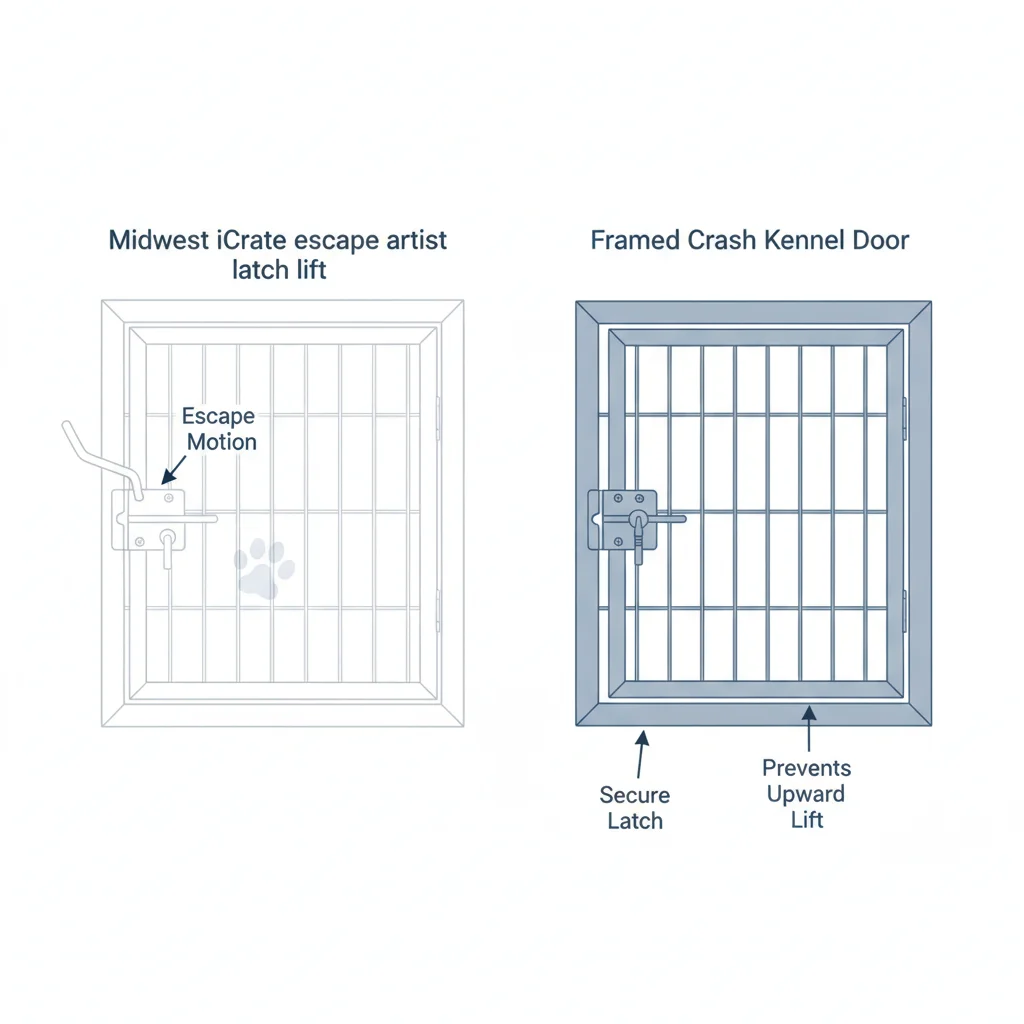
The MidWest iCrate is a suitcase-fold wire crate with a plastic tray, rounded corners, and one or two wire doors hung on vertical rods. Dual slide bolts are the marketing story. They are not a lock. Both bolts share one floppy door that can lift, rack, and leave the slots.
That design is excellent for house-training a non-Houdini, vet recovery, and hotel nights. It is the wrong product class once a dog has practiced the puzzle. Calling it escape-proof because a listing says “double latch” is how people own three crates in a year.
- Job it does: fold, store, travel, crate-train a dog that is not hunting the door.
- Job it does not do: hold a practiced door-lifter or latch paddler during a work day.
- Tell: if you can open it with two fingers through the grid, assume the dog can too.
Dual slide bolts versus a framed kennel door
Dual slide-bolt wire doors fail the same way every time: lift the bottom rail, rack the panel, walk out—zip ties only delay the next practice session. The bolts must stay aligned with their slots. A shoulder bump diamonds the front grid, and alignment dies even when the bolts still look closed.
Crash kennels use a framed hatch. Gunner-style rotomolded doors seat into a shell. Impact-style aluminum doors use slam or butterfly latches plus side rails on collapsible models. You cannot lift those doors out of plane the way you lift an iCrate grid. That is the comparison, not “steel versus plastic” slogans.
If you need the failure taxonomy in more detail, our notes on crate latch failure modes match each trick to hardware. An iCrate is the textbook slide-bolt case.
Wire gauge, panel flex, and the plastic tray
iCrate wire is consumer gauge. A 30–50 pound dog hitting a side panel at a run bows it. Once a panel diamonds, the latch is a costume. Bar spacing also lets terrier muzzles work a gap that looked fine on day one.
The tray is a rust and rattle story in humid walk-ups. It slides, clacks on tile, and weeps after accidents. Rubber feet help less than a dense mat. Wheels, when present, drum on laminate at 6 a.m. Neighbor noise is a lease issue, not a vibe.
- Press the front panel with a knee. If it bows, skip it for a Houdini.
- Check corners for grind marks hiding under paint.
- Expect tray rust in bathrooms and kitchens with poor exhaust.
Why Noliva-style lists still rank it for Houdinis
Affiliate roundups need SKUs that convert. The iCrate is cheap, Prime-eligible, and already in every “best crate” template. Dual-door photos look serious. Nobody films a nose-lift. Chewy education posts still mix furniture crates and foldable wire as if they were one category.
We treat those rankings as a warning, not a shortlist. If a page ranks an iCrate next to Gunner without naming latch class, it is a catalog, not a test. Shoppers who already lost an iCrate should not buy the same geometry in a larger size because a listicle used the word Houdini.
How apartment Houdinis beat an iCrate
Apartment escape is usually a hallway tour, not a movie chew-through. The dog wants out because you put on shoes, a truck passed, or the neighbor’s door slammed. The iCrate teaches the puzzle fast: the door is light, the bolts are reachable, and the floor is a launch pad.
Watch a phone video of the last breakout. If you do not have one, assume door-lift plus panel flex until proven otherwise. That pair kills most double-bolt wire doors, including the iCrate’s.
Door-lift and bottom-rail pops
Door-lift is the apartment classic. The dog hooks the bottom rail with a nose or paw, pops the bolts out of their slots, and walks into the hallway. Double doors do not fix this. They add a second hanging grid with the same rods.
A heavier iCrate size does not stop lift. It can make rattle louder and the tray looser. Framed hatches fight lift because the door cannot rise independently of the shell. That is why crash kennels show up in our escape-proof apartment crate shortlist and the iCrate does not.
- If bolts sit proud of the slots after a bump, the door already racks.
- Blankets stacked against the door give footholds. Remove them.
- Do not prop the door with a shoe. That is training, not convenience.
Latch paddling through the grid
Latch padders work bolts like piano keys. iCrate bolts are designed for human fingers through the wire. After a week of practice, a paw or snout does the same motion. A second bolt is not a lock if both bolts share one floppy door.
Aftermarket crate latches and carabiners help only if they take load when the door is racked. Many add a lever the dog can still rake. If you keep a foldable crate at all, budget a latch upgrade as a real line item, then re-test with the door under load—not empty on the kitchen island.
Zip ties are a weekend hack. They chew off, UV-fail, and become clank toys that wake the neighbor below. They are not a product class change.
Bar spread, chew, and a racked front panel
Some dogs never open the latch. They spread bars, crush corners, and work a jaw into a gap. Thin-gauge foldables flex when a dog hits the side at a run. Once the front panel diamonds, even fully seated bolts no longer line up.
Chewers peel the tray lip and work welds that were only spot-joined. An iCrate is not a chew kennel. Impact High Anxiety-style stock and smaller vents exist for that job. Buying a 42-inch iCrate after a 36-inch failure is not a chew strategy. It is a larger toy.
If the front panel already diamonds, stop buying clips. Geometry is gone. Upgrade the crate class or stop using a crate until a professional says confinement is appropriate.
iCrate vs crash kennels vs heavy-duty clones
Three product classes share the same SERP. Only one of them is the iCrate’s actual peer: other consumer foldable wire. Crash kennels are a different geometry. Amazon “indestructible” foldables often keep iCrate latch logic with thicker paint.
| What we check | Midwest iCrate (typical) | Crash kennel (Gunner / Impact / Ruff Land class) | Amazon “heavy-duty” foldable |
|---|---|---|---|
| Shell | Foldable wire grid, clipped panels | Rotomolded polyethylene or 5052 aluminum | Folding wire, often shared OEM panels |
| Door / latch | Wire door on rods; dual slide bolts | Framed hatch; paddle, slam, or rotary plus locks/rails | Usually dual slide bolts on a hanging door |
| Door-lift resistance | Fails as designed | High if latches seated and rails installed | Low unless you verified a different latch |
| Folds for a studio closet | Yes, suitcase fold | Gunner no; Impact Collapsible ~8 inches; High Anxiety no | Yes |
| Empty weight (mid size) | Often under 25 lb | G1 Intermediate ~48 lb; 34-inch Collapsible ~35 lb | Often 25–40 lb plus a loose tray |
| Apartment noise | Tray, bars, and paw ping on tile | Quieter shell; can boom on body-slam; aluminum ping if bumpers fall off | Tray, wheels, bar chatter |
| Who it actually holds | Casual nosers and crate-training dogs | Lifters and paddlers (Gunner); chewers (High Anxiety) | Casual nosers, not practiced Houdinis |
| Street price class (2026) | Roughly $40–$120 | Roughly $550–$1,000+ | Roughly $80–$200 |
An iCrate 42 is often the largest foldable that still clears an apartment door swing; crash kennels that actually hold a Houdini need a tape measure and a two-person carry plan. Fit is a pass/fail. A kennel that holds a Houdini in a garage is useless if it cannot turn the corner past the recycling bins.
Latch, footprint, and neighbor noise
Measure width, depth, door arc, and elevator interior before you click Buy. Tape the outline on the floor, including the swing. Leave a night path to the bathroom. If the only spot is in front of a radiator or a fire-escape window, pick a different size—or a different containment plan.
Plastic/composite shells damp metal ping. They can still boom when a dog body-slams. Steel sings. A dense mat under any crate helps more than a $12 “quiet crate” pad. If the complaint from next door is barking, a crate will not fix it.
For brand-level tradeoffs inside the crash class, see Gunner vs Impact vs Amazon crates. The iCrate does not belong in that table as a peer. It belongs as the crate you already beat.
- Quietest shell: rotomolded, mat underneath
- Quietest move: foldable wire, if you accept latch risk
- Worst of both: thin wire on wheels with a loose tray—the iCrate’s default apartment soundtrack
Price versus how many crates you will buy
An $80 iCrate looks cheap until you buy a second after the first weekend, then a “heavy-duty” clone, then a crash kennel. Count replacements, not the first receipt. Count also the security deposit conversation after hallway scratches and 6 a.m. tray rattle.
Crash kennels cost more because the door is a different machine. You are paying for geometry, not a logo. If the hallway cannot accept that geometry, do not force a G1 Large through a 28-inch door. Choose a collapsible crash design or stop using a crate as the work-day plan.
Which class matches which escape trick
Match the crate to the trick. Padders need hardware you cannot operate through the bars with a paw. Lifters need a door that cannot rise. Chewers need bar gauge and a tray they cannot peel. Buying “more steel” without naming the trick is how iCrate owners stay in the same aisle.
- Door-lift: framed hatch. Not another iCrate.
- Latch paddle: rotary, pin, or slam latches the dog cannot rake through a grid.
- Chew / bar spread: thicker stock, smaller vents. Not a larger wire box.
- Must fold weekly: Impact Collapsible-class with rails treated as part of the latch—not optional extras.
When an iCrate is still the right crate
We are not anti-iCrate. We are anti-mislabeling. Plenty of apartment dogs never hunt the door. For those dogs, a foldable wire crate is the honest buy: cheap, light, and gone into a closet on Friday.
Use an iCrate when the dog rests, does not paddle, and has never lifted a door. Use it for travel days when you will be in the room. Use it as a recovery crate when a vet says the dog will be sedate. Do not use it as the 9-to-5 plan after a documented breakout.
House-training, travel, and non-Houdini dogs
House-training wants a snug foldable you can move between rooms. The iCrate does that. Hotel nights want something that passes through a lobby without a two-person carry. The iCrate does that too. Those jobs are real. They are not the Houdini job.
If you crate only while you shower, an iCrate is often enough. If you crate for eight hours in a thin-walled building, latch class and noise both matter. Do not let a house-training success story sell you the same crate for a practiced escape artist.
Why sizing up the same crate wastes money
A larger iCrate gives more run-up to the door and more panel to flex. Escape artists do not “grow out” of a latch puzzle. They get better at it. Size for adult length plus a small turnaround, in the right product class—not in a bigger version of the crate they already opened.
Divider panels inside an iCrate help house-training. They do not reinforce a hanging door. If a relative sends a 42-inch iCrate after you said Houdini, screenshot this section. Kindness is not hardware.
What to buy instead (and when not to crate)
Step off consumer dual-bolt wire. If the hallway accepts a rigid shell, choose a Gunner-style rotomolded kennel for lifters and paddlers who need a quieter cabin, or an Impact High Anxiety-style box for chewers. If the hallway demands a fold, choose a collapsible crash design and treat rails as part of the latch.
Keep Amazon heavy-duty foldables as a labeled stopgap only. Many share iCrate latch geometry with thicker paint. Thickness without a framed door is a heavier toy. Verify welds, gauge, and latch class in photos you can zoom—not in a title that says indestructible.
Crash and welded picks that fit hallways
Tape first. G1 Intermediate versus Large is a hallway decision as much as a dog-length decision. Interiors on crash kennels run snug by design. Do not assume a “42-inch” Amazon label matches a G1 Large. Walk-ups need a two-person carry plan for the heavier shells.
Ruff Land-style polyethylene kennels do similar framed-door work with different latch kits. Verify the exact latch generation. Older gates are not the same as current ones. Welded steel with a door that seats into a channel can work if you confirmed the latch is not another dual slide bolt.
The shortlist lives on our escape-proof apartment crate hub. This page exists to stop the iCrate detour before you spend another weekend on clips.
12–18 month wear the iCrate never survives
Clone listicles stop at unboxing. Apartment ownership is rust, sag, and rattle. iCrate trays weep. Hinges loosen. Panels diamond and stay diamonded. You cannot “refresh” that crate with a new tray and call it rebuilt.
Crash kennels have their own 12–18 month story: missing door bumpers, hinge wear, and floor protection. That is still a better curve than buying a new foldable every season. Our notes on 12–18 month crate wear cover welds, tray rust, and wheel rattle in humid walk-ups.
- Recheck latches after week four, when sag starts.
- Recheck again at a year for rust and neighbor noise.
- Do not wait for a second hallway escape to admit the class was wrong.
Separation distress versus hardware escape
Hardware escape is a puzzle: lift, paddle, flex, walk out. Separation distress is injury: teeth, nails, neck, and a crate that becomes a weapon. A stronger box can make panic worse. Use confinement only if a veterinarian or qualified behavior professional says it is appropriate.
Do not crate as punishment. Do not stack footholds against the latch. If you need eyes on the dog after you leave, a camera is part of the plan. Neighbor noise from pawing is also a building problem; thin floors transmit everything.
If the dog only destroys things after you leave, solve welfare before you solve steel. An iCrate failure in that context is not a reason to buy a crash kennel as a substitute for a behavior plan. It is a reason to stop improvising.
Frequently Asked Questions
Is a Midwest iCrate escape-proof for a Houdini dog?
No. The iCrate is a foldable consumer wire crate with dual slide bolts on a hanging door. Determined apartment dogs lift the bottom rail, paddle the bolts, or flex the front panel until the latch no longer seats. It is a house-training and travel crate, not a work-day containment plan after a documented breakout.
Why do some sites rank the iCrate for escape artists?
Because it is cheap, photogenic, and in every Amazon feed. Dual-door, double-latch marketing sounds like a lock. Rankings that copy Chewy or Noliva lists rarely film a door-lift. A second bolt on a floppy wire door is not framed-kennel hardware.
Will zip ties or carabiners make an iCrate hold?
They buy hours, not months. Ties chew off, UV-fail, and become rattle toys. Carabiners help only if they take load when the door is racked. If the front panel already diamonds, clips cannot restore geometry. Upgrade the crate class instead of decorating the same door.
What should I buy instead of another iCrate?
Match the trick. Door-lifters and paddlers need a framed hatch (Gunner-style) or a slam/rotary latch with rails (Impact-style). Chewers need thicker stock and smaller vents, not a larger wire box. Tape hallway swing first; a kennel that will not turn the corner is the wrong kennel.
Is a stronger crate safe if my dog has separation anxiety?
A stronger crate is not treatment. Dogs in panic can injure themselves on expensive hardware. Use a crate only with professional guidance, and put cameras and a training plan alongside the kennel. If the dog only destroys things after you leave, solve welfare before you solve steel.
Your next step
Name the escape trick, tape the footprint including door swing, then buy the class that matches both. If the dog already beat an iCrate, stop shopping dual slide-bolt wire. If the hallway says a mid-size crash kennel fits, stop decorating the old door with carabiners.
Recheck latches after week four. That is when sag, missing bumpers, and rust start arguing with the unboxing photos—and with every listicle that still ranks the iCrate for Houdini dogs.
Related reading on our sister sites: Puppy Playpen