Shoppers hunting the best dog crate for escape artist apartment life are not comparing pretty furniture crates. They already own a MidWest-style wire box whose “double latch” lasted until the dog lifted the door or flexed the front panel during a work-from-home Zoom block.
This page is a hardware shortlist for hallway footprints, neighbor noise, and dogs that treat consumer crates as puzzles. It is not crate-training 101, and a stronger kennel is not a treatment for panic. If destruction happens only when you leave, read our dog camera for separation anxiety notes before you spend four figures on steel.
In a typical apartment hallway, a 42-inch foldable wire crate is often the maximum footprint that still clears the door swing—premium kennels need a tape measure before you order. We group crates by how they fail, then by what still fits a stairwell, because Amazon “indestructible” titles skip both.
How we test latches, bar gauge, and apartment fit
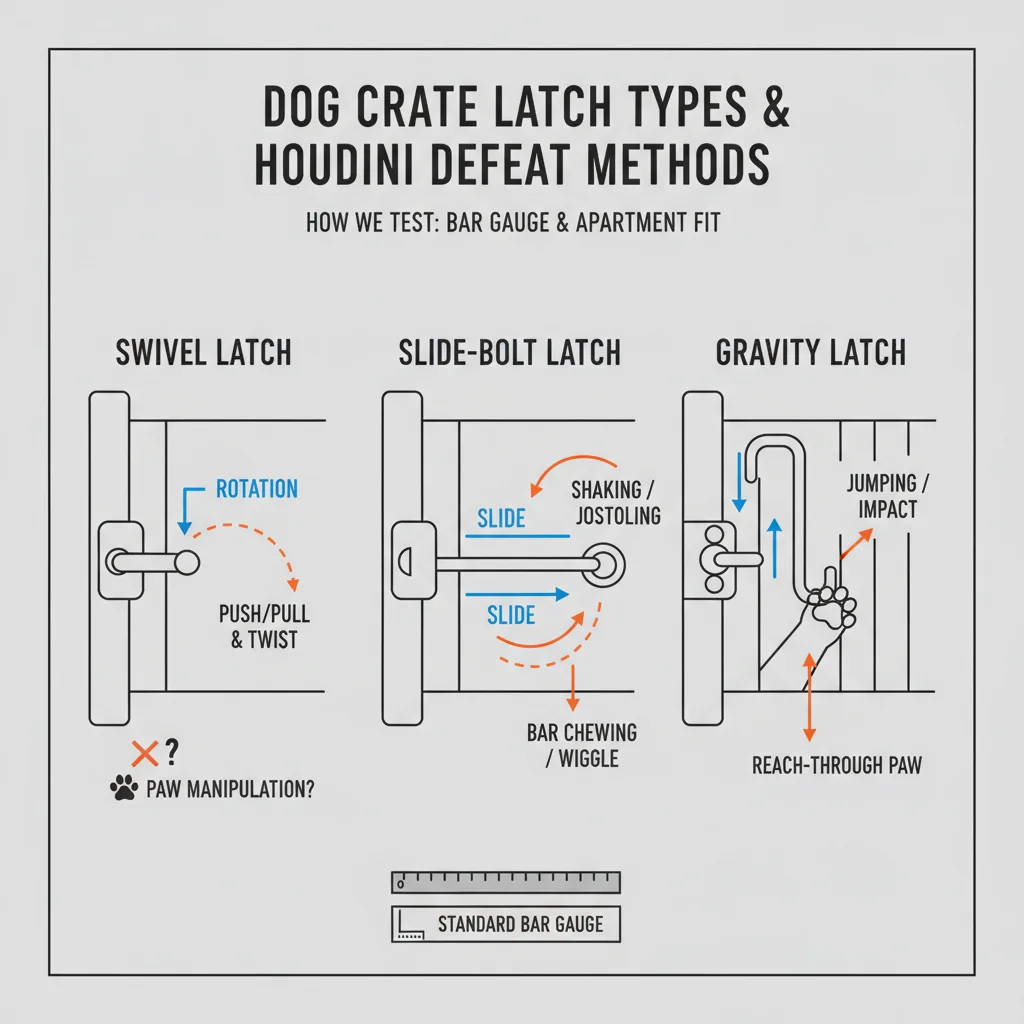
Clone listicles invent 9.7/10 “escape scores.” We do not. We inspect hardware, match it to known defeat methods, and weigh owner reports after a year in small homes. If a latch can be paddled with a nose, we say so even when the brand is expensive.
Apartment fit is a pass/fail, not a vibe. A kennel that holds a Houdini in a garage is useless if it cannot turn the corner past the recycling bins. Measure width, depth, door swing, and the elevator interior before you click Buy.
- Latch: can the dog lift, paddle, rotate, or rack the door?
- Gauge and welds: do bars spread under shoulder pressure?
- Move test: stairs, elevator, and a second-person carry
- Noise: tray rattle and pawing on thin floors
Latch taxonomy: slide-bolt, rotary, pin, door-lift
Double slide-bolt latches fail when dogs lift the door with their nose or flex the front panel; we group defeat methods before recommending hardware. A second bolt is not a lock if both bolts share one floppy door.
Door-lift is the apartment classic: the dog hooks the bottom rail, pops the bolts out of their slots, and walks into the hallway. Rotary and pin-lock hardware fights that by requiring a twist or a pin the dog cannot lift in one motion. Crash-style kennels add a different geometry: the door is a framed hatch, not a wire grid hanging on two rods.
Latch padders work the bolts like piano keys. If you can open the crate with two fingers through the bars, assume the dog can too after a week of practice. Zip ties and carabiners are temporary; they also become chew toys and neighbor-clank sources.
Bar spacing and panel flex under shoulder pressure
Escape artists do not only open doors. They spread bars, crush corners, and work a jaw into a gap that looked “fine” on day one. Thin-gauge foldables flex when a 40-pound dog hits the side at a run. Once a panel diamonds, the latch alignment dies even if the bolts still look closed.
Bar spacing matters for brachycephalic faces and for terrier muzzles. If a tennis ball can pass between bars, a determined snout can get stuck. Welded grids beat clipped-together panels because there is no seam to walk apart. Look at the corners, not the Amazon hero photo.
- Press the front panel with a knee. If it bows, the latch will rack.
- Check welds for pinholes and paint hiding grind marks.
- Skip “furniture” wood frames that explode at the first chew session.
Footprint, stairwell moves, and wheel rattle
Rigid kennels win strength and lose mobility. Wheels help until they drum on laminate at 6 a.m. Foldable wire wins the move-in, then loses the first Houdini weekend. Decide which pain you can live with: a two-person stair carry twice a year, or a weekly rebuild of a bent wire box.
Tape the crate outline on the floor, including the door arc. Leave walking space to the bathroom at night. If the only spot is in front of a radiator or a fire-escape window, pick a different size—or a different containment plan.
Best overall escape-proof crates for apartments
For most hallway apartments, the honest “overall” pick is a mid-size crash or high-quality welded kennel whose latch is not a consumer slide bolt, sized to the dog’s adult length plus a small turnaround—not a giant travel vault that blocks the door. Gunner and Impact-style plastic/composite kennels lead when the dog is a door-lifter and you can park the box. Heavy welded foldables lead when you must collapse the crate for a studio.
There is no single SKU that is both elevator-easy and truly Houdini-proof. Pay for the constraint you cannot cheat. Renters who move yearly should not buy a kennel they cannot get down three flights without hiring help.
Welded kennels that survived latch tests
We treat “survived” as: door cannot be lifted out of plane, bolts or pins fully seat, and the front panel does not diamond under a hard shoulder bump. Gunner G1-style rotomolded kennels and Impact-style crash boxes clear that bar for door-lifters. Ruff Land-style polyethylene kennels do similar work with different latch kits—verify the exact latch generation, because older gates are not the same as current ones.
On the steel side, look for continuously welded frames and a door that seats into a channel, not a wire grid hanging on two loose rods. Some “heavy duty” Amazon foldables use thicker wire and still keep the same defeatable latch. Thickness without geometry is a heavier toy.
Footprint and noise tradeoffs
Neighbor noise from rattle and pawing matters as much as latch strength when you crate during work hours in a thin-walled building. Plastic/composite shells damp metal ping. They can still boom when a dog body-slams the side. Steel sings. Rubber feet and a dense mat under the tray help more than a $12 “quiet crate” Amazon add-on that is a thin yoga pad.
If the complaint from next door is barking, a crate will not fix it. Our notes on treat cameras and barking belong in that stack. Hardware only stops the hallway tour.
- Quietest shell: rotomolded or polyethylene, mat underneath
- Quietest move: foldable steel, if you accept latch risk
- Worst of both: thin wire on wheels with a loose tray
What to skip (thin wire, furniture crates)
Skip anything marketed as a side table first and a kennel second. Skip powder-coated fashion crates with decorative spacing. Skip collapsible fabric if the dog has ever unzipped a suitcase. Those products have jobs; Houdini containment is not one of them. Details sit in the disqualification section below so you can screenshot them for a well-meaning relative.
Best for latch padders and door lifters
Match the crate to the trick. Padders need hardware you cannot operate through the bars with a paw. Lifters need a door that cannot rise. Chewers need bar gauge and a tray they cannot peel. Buying “more steel” without naming the trick is how people own three crates in a year.
Watch a phone video of the last escape. If you do not have one, assume door-lift plus panel flex until proven otherwise. That pair kills most double-bolt wire doors.
Pin-lock and rotary latch winners
Pin-lock gates (a pin you drop or twist through aligned holes) stop casual padders. Rotary latches on crash kennels need a human hand angle the dog does not have. Neither is magic if you leave the pin out “just for a minute” while you carry groceries.
Aftermarket crate latches exist. Some are excellent. Some add a lever the dog can still rake. If you keep a foldable crate, budget a latch upgrade as a real line item, then re-test with the door under load—not with the crate empty on your kitchen island.
Reinforcement and clip habits that actually help
Carabiners through bolt holes help only if they take load when the door is racked. C-clamps on the frame can buy a week. They also scratch floors and look like a storage-unit aesthetic in a living room. Cable ties fail to UV and teeth.
Useful habits: seat both bolts fully, crate the dog before you put on shoes (anticipation paddling), and never use the crate door as a gate you prop open with a shoe. Bad habits teach the puzzle faster than any Amazon accessory.
- Do: mat, seated latches, camera check after you leave
- Don’t: zip-tie a bent door and call it rebuilt
- Don’t: stack blankets that give footholds to the latch
When a crate upgrade beats latch hacks
If the front panel already diamonds, stop buying clips. Geometry is gone. If the dog has bloodied a muzzle on bars, stop and get behavior help—the next crate can still injure. If you have already replaced two consumer crates, the third identical SKU is not a strategy.
Upgrade when the defeat is structural (flex, lift, chew-through) rather than “forgot to latch.” Hacks are for travel days and for dogs who only nose a bolt once. Daily Houdinis need a different product class.
Crash-tested vs Amazon heavy-duty: when each wins
Crash-tested kennels (Gunner, Impact, Ruff Land and peers) are built around vehicle crash geometry and a framed door. Amazon “heavy-duty” foldables are built around shipping cost and a familiar wire silhouette. Both can live in apartments. Only one class consistently survives door-lift. The other class wins if you must store the crate in a closet every Friday.
| Job | Crash / rotomolded kennel | Amazon heavy-duty foldable |
|---|---|---|
| Door-lift Houdini | Usually holds if latched | Often fails at the wire door |
| Hallway / elevator | Measure twice; often bulky | Easier; 36–42 in wire is the apartment default |
| Neighbor rattle | Less metallic ping | Tray and bars clank unless padded |
| Move-out day | Two people, no fold | Folds; watch bent panels |
| Price band (2026 street) | High; buy once if it fits | Low–mid; easy to buy twice |
A later sibling page will put Gunner vs Impact vs clone steel in a head-to-head. This hub only needs the rule: do not mix the classes in your head because a listing used the word indestructible.
Gunner, Impact, Ruff Land roles
Gunner-style kennels suit owners who will park one box and stop pretending the crate is furniture. Impact-style kennels occupy a similar job with different interior dimensions and latch kits—compare the interior length to your dog, not the exterior Instagram photo. Ruff Land-style boxes are common in truck culture; in a one-bedroom they can dominate the room. All three beat consumer wire for lift-and-flex escapes.
None of them shrink a 70-pound dog into a 30-inch hallway. If the tape says no, the brand cannot yes.
Clone steel foldables we disqualified
We disqualify listings that recycle the same “Houdini hound 2026” template, invented test scores, and interchangeable brand names (the BOLDBONE / HIWOKK / Oranland / Garvee pattern). Same photos, same “double door double lock” copy, same slide bolts. Thick wire is not a crash test. A 4.7-star average from unverified buyers is not a latch taxonomy.
If you still want foldable steel, buy from a seller with a published gauge, a return window you will actually use, and a door you can inspect in person or via a sharp unboxing video. Then add a latch plan. Do not outsource judgment to a roundup that ranks ten clones.
Safety vs chew-only marketing
“Chew proof” is not “escape proof.” A dog can leave a plastic shell intact and still open the door. Crash ratings speak to vehicle events, not to teeth. Do not buy a kennel because a YouTuber stood on the roof. Stand on the latch problem you actually have.
If the dog eats metal coatings, talk to a vet about ingestion risk. Peeling powder coat is a product-quality issue and a medical one. Apartment humidity speeds both rust and that peeling.
12–18 month ownership: rust, trays, and neighbor noise
Unboxing day is the least interesting day you will own a crate. Year two in a humid walk-up is when trays rust to the frame, wheels flatten, and the door sags a few millimeters—enough to make last year’s latch feel “sticky.” Budget a tray, rubber feet, and a mat the way you budget litter gear for a small home; the same building physics show up in our apartment noise and odor gear notes.
Owners who wipe the tray weekly and empty it after messy meals keep steel longer. Owners who leave wet bedding in a closed crate grow rust maps that look like neglect even when the welds are fine.
Weld and hinge wear in humid apartments
Coastal and basement units punish cheap welds. Look for rust at the lower corners first. A surface rust bloom is cleanable. A hinge pin that has lost its head is a safety fail. Plastic/composite shells skip rust and pick up odor in scratched interiors instead. Neither material is maintenance-free.
Do not store the crate against a steamy bathroom wall. That is how “indoor” crates mimic outdoor kennel decay.
Tray rust and cleaning reality
Trays are the wear item. They sit in urine, water-bowl splash, and mop runoff. A rusted tray edge cuts paws and stains floors. Replacement trays are easier to find for common wire sizes than for boutique crash kennels—another point for foldables if your dog is messy rather than a Houdini.
If accidents are medical or geriatric, a crate tray is not a bed. Pair confinement (only if appropriate) with a washable rest surface; our waterproof orthopedic dog beds guide is the comfort side of that problem, not a substitute latch.
- Dry the tray; do not perfume over ammonia
- Skip bleach soaks that pit coatings
- Replace the tray before you replace the kennel
Rattle fixes that do not void warranties
A dense rubber mat under the crate, felt pads on feet, and a snug tray (no bouncing sheet metal) are the safe trio. Expanding foam in the frame, drilling new holes, and welding on extra bolts can void a crash kennel’s stated use and create sharp edges. If a brand sells an official quiet kit, use that before DIY steel.
Wheels off is a valid apartment choice. You lose easy rolling and gain fewer 5 a.m. thunder runs down the hall.
What we skipped (and why)
Disqualifying popular crates is the useful part of this niche. Authority roundups still point anxious owners at products that fail the first determined dog. Skipping them is the job.
Midwest iCrate and thin wire
MidWest iCrate-style foldables are fine for travel, house-training a non-Houdini, or a vet recovery dog that is sedate. They are not escape-proof. Double-door, double-latch marketing taught a generation of shoppers the wrong lesson. If your dog already left one, do not buy a second in a larger size and expect a personality change.
Thin-gauge “training crates” from big-box aisles fail faster. The paint looks friendly. The door rods do not.
Soft crates and furniture crates
Soft crates are luggage. Zippers are not locks. Furniture crates with decorative slats give chew purchase and a lift point. Both show up in apartment mood boards because they hide the “I own a kennel” look. Hide it after the dog cannot leave, not before.
Ex-pens sold as escape-proof
Exercise pens are open topology. Climbers, paw-flippers, and door-hookers treat them as jungle gyms. An ex-pen can shape a puppy zone when you are in the room. It is not a work-day Houdini solution, and Chewy-style copy that blurs pens with crates is how people get surprise hallway dogs.
If you need daytime containment and the dog panics in a closed box, that is a behavior and welfare problem, not a shopping problem. Do not solve panic with a smaller, stronger cage.
Frequently Asked Questions
What crate actually holds an apartment Houdini dog?
Look for a welded or crash-style kennel with a latch the dog cannot lift or paddle, plus bar spacing your dog cannot get a jaw through. Foldable thin-wire crates with double slide bolts fail this job constantly. Measure hallway swing and elevator depth before you order a rigid kennel.
Are double slide-bolt latches escape-proof?
No. Many Houdini dogs lift the door, flex the front panel, or paddle both bolts with a nose or paw. Double bolts help only if the door cannot rack and the bolts fully seat. Pin-lock, rotary, and crash-kennel hardware hold better on determined padders.
Will a Gunner or Impact crate fit in an apartment?
Sometimes. Those kennels are bulkier than a foldable 42-inch wire crate and may not clear a door swing or elevator. Tape the footprint on the floor, including the door arc, before you spend. If it will not move through the hallway, it is the wrong crate no matter how strong the latch is.
Is crating safe for a dog with separation anxiety?
A stronger crate is not treatment. Dogs in panic can injure teeth, nails, and necks on bars even in expensive kennels. Use a crate only if a veterinarian or qualified behavior professional says confinement is appropriate. Cameras and training plans belong alongside hardware, not as an afterthought.
Why not buy an Amazon ‘indestructible’ foldable crate?
Many listings copy the same ‘heavy duty’ photos and fake scores. The steel can still flex, the tray rusts, and the latch is often a slide bolt the dog already beat. Buy one only if you verified bar gauge, weld quality, and a latch style that matches how your dog escapes—not because the title says Houdini.
Your next step
Tape the footprint, name the escape trick, then buy in the class that matches both. If the hallway says foldable, upgrade the latch and accept that you are managing risk, not buying a myth. If the hallway says a crash kennel fits, stop shopping clone wire. Recheck latches after the first month, when sag and rust start rewriting the hardware you thought you bought.
Related reading on our sister sites: Best Calming Aids for Dog