Shoppers running a crash tested dog crate vs heavy duty comparison are usually mixing two labs that never share a protocol. One test scores a kennel in a vehicle. The other is a marketing phrase for thicker wire, a louder tray, and the same dual slide bolts the dog already beat.
Crash tests score a kennel in a vehicle. They do not score a nose-lift on a hanging wire door in a hallway. If the last breakout was a latch puzzle during a work block, a Center for Pet Safety logo will not unpack that video for you.
This page is a spec taxonomy, not a star-rating grid. We separate crash labels, chew geometry, and Amazon “indestructible” steel so apartment buyers stop paying twice. A stronger box is not treatment for panic. If destruction starts only after you leave, read our dog camera for separation anxiety notes before you spend four figures on a kennel.
Crash, chew-proof, and heavy duty are three tests
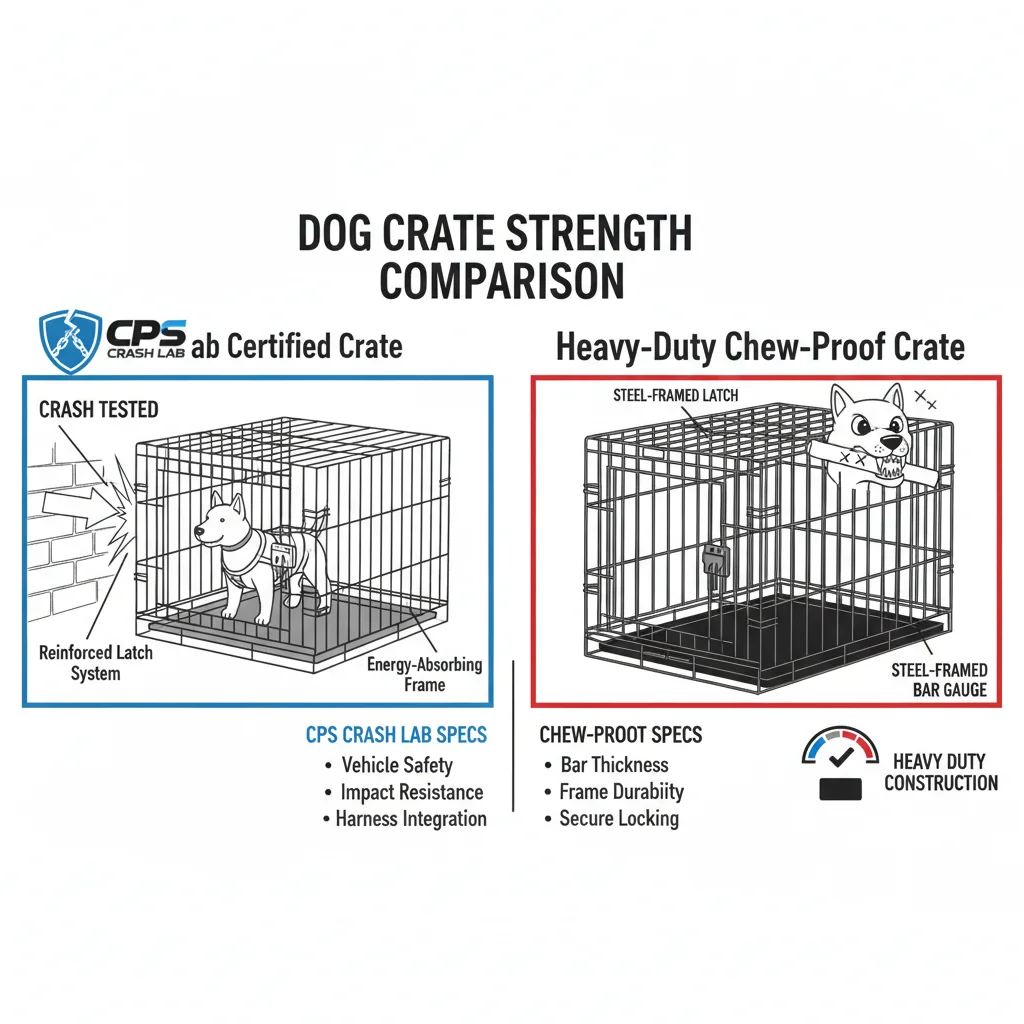
Clone listicles mash the three labels into one column called “durability.” That column is how MidWest iCrates and BOLDBONE-style foldables sit next to Gunner in the same roundup. The jobs are not the same.
Crash testing is a vehicle story: straps, deceleration, and whether the shell stays intact for the animal inside. Chew-proof is a geometry story: bar gauge, vent size, weld quality, and corners a jaw can peel. Heavy duty, on Amazon, is usually a search-ad story.
- Crash: how the kennel behaves when a car hits something, strapped as specified.
- Chew: whether stock, vents, and trays survive teeth and nails over months.
- Heavy duty: a listing adjective until you can name gauge, weld, and latch class.
Why the same SERP mixes vehicle labs and Amazon steel
Google treats escape-proof crate queries as a commercial listicle SERP. Amazon category pages and clone “best of 2026” posts recycle the same foldable SKUs with invented test scores. True crash brands appear in titles and almost never get a spec table that would disqualify the clones.
Apartment modifiers make it worse. Furniture-crate content talks sizing and wood grain. Houdini threads talk zip ties. Nobody writes the mapping: crash sticker versus latch class versus chew stock. That mapping is the buying work.
Amazon “indestructible” and “chew-proof” titles usually describe thicker paint on dual slide-bolt geometry, not a framed hatch. If you already filmed a door-lift, you do not need another coat of black powder. You need a different door machine.
The spec sheet you should demand before you buy
Ask for five numbers or names, not a vibe. Latch class. Door construction. Shell material. Empty weight. Footprint including door swing. If a seller cannot answer those, you are shopping a photo.
Then add the chew line if your dog attacks steel: published bar or wall thickness, vent dimensions, weld type, and tray attachment. I-BAR and Center for Pet Safety labels are not interchangeable with bar gauge; a crate can pass a crash protocol and still lose a chew-out at the vents.
- Latch you cannot paddle through the grid with a paw.
- Door that cannot rise independently of the shell.
- Stock and vents matched to chew, not to a “42-inch” marketing size.
- Weight and width that clear the stairwell and elevator.
For the latch taxonomy itself—slide-bolt padders, door-lift, panel flex—use our notes on crate latch failure modes. This page stays on the labels people confuse.
What crash testing actually measures
Crash claims exist because people transport dogs. They are not a substitute for apartment containment. A kennel can be excellent on the highway and still lose a Houdini at 9 a.m. on laminate because the door is the wrong class.
Read the protocol, the size, and the strap instructions. “Crash tested” on a marketplace card is not the same as a named lab, a named size, and a named installation. Treat unnamed crash as unnamed.
Center for Pet Safety versus a crash sticker on a listing
Center for Pet Safety crash certification is a vehicle-safety protocol. It applies to specific sizes, strapped as the lab specifies. Gunner publishes CPS status by size: Small, Medium, and Intermediate when used as specified; Large is not CPS-certified. That sentence is more useful than a badge crop on an Instagram reel.
Impact markets load strength. The Collapsible is not CPS crash-certified. Ruff Land-style polyethylene kennels sit in the same product class with different latch kits and different paperwork. If the brand will not say which SKU was in which test, you do not have a crash spec. You have a vibe.
Clone foldables sometimes print a crash silhouette next to a drop-test anecdote. A crate falling off a tailgate is not a lab protocol. Do not let a cartoon car argue with a hallway video of a lifted bolt.
I-BAR, load claims, and what they never prove
I-BAR-style load claims describe how a shell or frame behaves under stacked or crushing force. That can matter in a truck bed or a stacked kennel run. It does not tell you whether a dual slide bolt stays in its slot when a 40-pound dog hooks the bottom rail.
Load and crash both ignore neighbor noise, tray rust, and whether you can turn the crate in a 90-degree hallway. Those apartment constraints fail purchases that would look fine in a garage. Tape the outline including swing before you worship a load number.
Brand-level crash-class tradeoffs—Gunner rotomold versus Impact aluminum versus Amazon foldables—live on our Gunner vs Impact vs Amazon crates comparison. Use that page for SKUs. Use this page to stop treating their spec sheets as one column.
When a crash kennel still fails an apartment Houdini
Crash kennels fail apartment jobs when the latch is not seated, when required rails are left in the box, or when the dog is chewing vents the crash test never loaded with teeth. They also fail when the kennel never makes it through the door. Fit is a pass/fail, not a style choice.
Rotomolded shells can boom on a body-slam. Aluminum can ping if bumpers fall off. Neither sound is a crash-lab metric. Both are lease metrics in a thin-walled building. Put a dense mat under the kennel and recheck hardware after week four.
If the dog’s trick is latch paddle on a hanging wire door, a crash kennel with a framed hatch is the right class. If the trick is chew-through at a large vent, you need High Anxiety-style stock, not a bigger G1 because the listing said crash. Match the failure, not the logo.
Chew-proof specs that actually hold steel
Chew-proof is the most abused phrase in the crate aisle. Soft crates are not chew-proof. Furniture crates are not chew-proof. Most foldable wire crates are not chew-proof. A determined jaw finds the weakest rectangle: a wide vent, a spot weld, a tray lip, a plastic corner guard.
You can inspect chew specs without a lab. You cannot inspect them from a title that says indestructible. Zoom product photos. Bring a caliper if the crate is already in the living room. Press panels with a knee. If they diamond, geometry is already gone.
Gauge, welds, and bar spacing you can check
Gauge is thickness. Lower gauge numbers on wire usually mean thicker stock, but listings lie or omit the number. If the seller will not state gauge, assume consumer wire. Spot welds that look like paint blobs fail sooner than continuous welds you can see as a seam.
Bar spacing decides muzzle access. Terriers and bully mixes work a gap that looked fine on day one. Once a bar spreads, the next chew is easier. High Anxiety-style designs use thicker stock and smaller vents for this reason. A larger Amazon “42” with the same spacing is a bigger chewing gym.
- Ask for wall or wire thickness in millimeters or gauge, not “heavy.”
- Look for continuous welds at corners, not a single tack hiding under powder coat.
- Measure the largest vent or grid opening. That is the chew window.
Vents, trays, and corners dogs actually attack
Chewers do not attack the pretty front panel first. They peel trays, work door bumpers, and enlarge vents. Plastic trays in humid walk-ups rust the rails they sit on and give a chew lip. Rubber feet help less than a mat that stops the whole kennel from walking.
Rotomolded kennels still have vents. Large vents are cooling and a chew target. Aluminum High Anxiety boxes trade airflow for smaller openings. That is a real spec tradeoff, not an aesthetic. If your dog overheats in summer, a sealed look is also a welfare problem—do not solve chew by cooking the dog.
Twelve to eighteen months in an apartment is when rust, sag, and missing bumpers show up. Clone listicles stop at unboxing. Our notes on 12–18 month crate wear cover welds, tray rust, and wheel rattle in humid buildings. Budget that curve, not the launch photo.
Why thicker wire still loses at the latch
Thicker wire on a hanging dual-bolt door is still a hanging dual-bolt door. The dog lifts the bottom rail, racks the panel, and walks out. Gauge does not lock a floppy grid to a frame it does not have.
This is why “buy a heavier Amazon crate” fails after an iCrate breakout. You upgraded the chew story slightly and left the latch story identical. Latch class is independent of powder-coat thickness. Treat them as separate line items on the spec sheet.
If the front panel already diamonds, stop shopping thicker clones of the same door. Geometry is gone. Change product class or stop using a crate until a professional says confinement is appropriate.
Spec matrix: which class holds which Houdini
Three product classes share the SERP. Crash kennels (Gunner, Impact, Ruff Land class). Welded or thick-stock chew kennels. Foldable “heavy duty” wire. Only the first two have a chance against a practiced apartment escape artist, and they still split by trick.
| Spec to read | Crash kennel (Gunner / Impact / Ruff Land class) | Chew-focused welded or High Anxiety stock | Amazon “heavy duty” foldable |
|---|---|---|---|
| Primary test | Vehicle crash / load (by SKU) | Bar/vent geometry under teeth | Shipping weight and search ads |
| Typical shell | Rotomolded polyethylene or 5052 aluminum | Thicker aluminum or welded steel, smaller vents | Foldable wire grid, clipped panels |
| Door / latch | Framed hatch; paddle, slam, rotary, locks/rails | Framed or channel door; not dual slide bolts | Wire door on rods; dual slide bolts |
| Door-lift resistance | High if latches seated and rails installed | High if the door cannot rise | Fails as designed |
| Chew resistance | Shell strong; vents and bumpers are the weak line | Best of the three when vents are small | Low once bars spread |
| CPS / named crash | Some Gunner sizes yes; Collapsible Impact no | Usually not the selling point | None that survive scrutiny |
| Folds for a studio | Gunner no; Impact Collapsible ~8 inches | Usually no | Yes, suitcase fold |
| Empty weight (mid size) | G1 Intermediate ~48 lb; 34-inch Collapsible ~35 lb | Often 40 lb and up | Often 25–40 lb plus a loose tray |
| Who it actually holds | Lifters and paddlers when the hatch is used correctly | Chewers who destroy vents and bars | Casual nosers, not practiced Houdinis |
| Street price class (2026) | Roughly $550–$1,000+ | Often similar or higher | Roughly $80–$200 |
Read rows, not brand loyalty. A crash kennel with rails left in the closet is not a crash kennel. A chew kennel with a dual-bolt wire door is a contradiction. An $90 foldable with a crash silhouette in the hero image is still a foldable.
Latch geometry versus a crash logo
Latch geometry decides hallway escapes. Crash logos decide car wrecks. Buyers who skip the first and worship the second bring home a heavy box the dog opens anyway—or a certified kennel they cannot carry up three flights.
Padders need hardware you cannot operate through the bars with a paw. Lifters need a door that cannot rise. Chewers need stock and vents. If you cannot name the trick from a phone video, assume door-lift plus panel flex until proven otherwise. That pair kills most double-bolt wire doors.
- Door-lift: framed hatch. Not another foldable.
- Latch paddle: rotary, pin, or slam latches the dog cannot rake through a grid.
- Chew / bar spread: thicker stock, smaller vents. Not a larger wire box.
- Must fold weekly: collapsible crash design with rails treated as part of the latch.
Apartment footprint, stairs, and neighbor noise
Measure width, depth, door arc, and elevator interior before you click Buy. Tape the outline on the floor, including the swing. Leave a night path to the bathroom. If the only spot is in front of a radiator or a fire-escape window, pick a different size—or a different containment plan.
Plastic/composite shells damp metal ping. They can still boom when a dog body-slams. Steel sings. Wheels drum on laminate at 6 a.m. A dense mat under any crate helps more than a $12 “quiet crate” pad. If the complaint from next door is barking, a crate will not fix it.
Walk-ups need a two-person carry plan for G1 Large-class weights. An Intermediate that actually turns the corner beats a Large that lives in the hallway and becomes a trip hazard. Crash interiors run snug by design. Do not assume a “42-inch” Amazon label matches a G1 Large.
Price versus how many crates you will replace
An $80 “heavy duty” foldable looks cheap until you buy a second after the first weekend, then a louder clone, then a crash kennel. Count replacements, security-deposit conversations, and 6 a.m. tray rattle. Crash kennels cost more because the door is a different machine.
If the hallway cannot accept that machine, do not force it. Choose a collapsible crash design or stop using a crate as the work-day plan. Hardware that will not fit is not a bargain at any price.
The buying shortlist for apartment Houdinis lives on our escape-proof apartment crate shortlist. This page exists so you can disqualify fake crash and fake chew before you open that list.
How to shop the spec sheet (and when not to crate)
Shop like an investigator. Name the trick. Name the latch class that beats it. Name the chew stock if teeth are involved. Name the footprint. Then look at crash paperwork if you also transport the dog. Reverse that order and you buy a logo.
Keep Amazon heavy-duty foldables as a labeled stopgap only—house-training, hotel nights, a dog that has never hunted the door. Do not relabel them as escape-proof because the title used both “crash” and “chew-proof” in the same sentence.
A ten-minute hardware audit
On a listing: screenshot latch close-ups, vent size, empty weight, exterior dimensions, and any named lab with size caveats. If those five are missing, skip. On a crate you already own: try a gentle door-lift yourself. If bolts pop with two fingers, assume the dog already knows.
Press the front panel. Check corners for grind marks under paint. Rock the tray. Note whether wheels rattle. Recheck after week four, when sag starts. Recheck at a year for rust and neighbor noise. Do not wait for a second hallway escape to admit the class was wrong.
- Reject dual slide-bolt hanging doors for practiced Houdinis.
- Reject unnamed crash badges and fake numerical “test scores.”
- Reject “just size up” as a chew strategy.
- Reject a kennel that cannot turn your actual corner.
Separation distress versus a puzzle escape
Hardware escape is a puzzle: lift, paddle, flex, walk out. Separation distress is injury: teeth, nails, neck, and a crate that becomes a weapon. A crash kennel can make panic worse because the dog cannot get out and still cannot cope.
Use confinement only if a veterinarian or qualified behavior professional says it is appropriate. Do not crate as punishment. Do not stack blankets as footholds against the latch. If you need eyes on the dog after you leave, a camera is part of the plan, not a gadget afterthought.
If the dog only destroys things after you leave, solve welfare before you solve steel. A failed “heavy duty” foldable in that context is not a reason to buy a crash kennel as a substitute for a behavior plan. It is a reason to stop improvising.
Frequently Asked Questions
Is a crash-tested crate automatically chew-proof?
No. Crash protocols score how a kennel behaves when a vehicle hits something, usually with the crate strapped as specified. Chew-outs happen at vents, welds, and tray lips. A rotomolded shell can be crash-certified and still lose a determined chewer at a large vent or a loose bumper.
Does “heavy duty” on Amazon mean the crate is escape-proof?
Usually not. Heavy duty on foldable wire often means thicker paint, a second slide bolt, and a louder tray. Dual slide-bolt doors still lift. If the listing cannot name gauge, weld type, and latch class, treat “indestructible” as a search-ad adjective.
What is Center for Pet Safety certification on a dog crate?
CPS crash certification is a vehicle-safety protocol for specific sizes, strapped as the lab specifies. Gunner publishes CPS status by size; not every Gunner size is certified, and Impact collapsible models are not CPS crash-certified. Certification is not a hallway door-lift test.
Which specs matter most for an apartment escape artist?
Latch class first, then door geometry, then chew stock. Door-lifters and paddlers need a framed hatch they cannot raise or rake through the grid. Chewers need smaller vents and thicker stock. Empty weight and footprint decide whether the kennel even fits the stairwell.
Can I use a crash kennel if my dog has separation anxiety?
A stronger crate is not treatment. Panic can injure teeth, nails, and necks on expensive hardware. Use confinement only if a veterinarian or qualified behavior professional says it is appropriate. Cameras and a training plan belong beside any kennel, not as an afterthought.
Your next step
Write the escape trick on a note, then buy the spec class that matches it. If the video shows a door-lift, stop shopping dual slide-bolt wire no matter how heavy the paint. If the video shows chewed vents, stop shopping crash logos that never list vent size.
Tape the footprint including door swing. Recheck latches after week four. That is when sag, missing bumpers, and rust start arguing with every listicle that still treats crash-tested, chew-proof, and heavy duty as one word.
Related reading on our sister sites: Puppy Playpen