People hunting the best indoor dog gate for jumpers usually already own a 29–36 inch “extra-tall” walk-through that a 40-pound dog cleared in one hallway try. The box compared that height to a baby gate. Your dog compared it to a hurdle.
A 36-inch Carlson-class gate is not extra-tall for a 40 lb leaper in a narrow hallway. If the video shows a clean jump, shopping another 36-inch clone is the same purchase with a different color. If the video shows a dash through an open walk-through, height was never the failure.
This page ranks extra-tall indoor gates by jump clearance, latch geometry, mount type, and what the wall looks like after a year in a rental. It is not a baby-gate list, a playpen roundup, or a crate shortlist. When a gate is the wrong tool, we say so and point at the right class.
How we test jump clearance, latch height, and wall damage
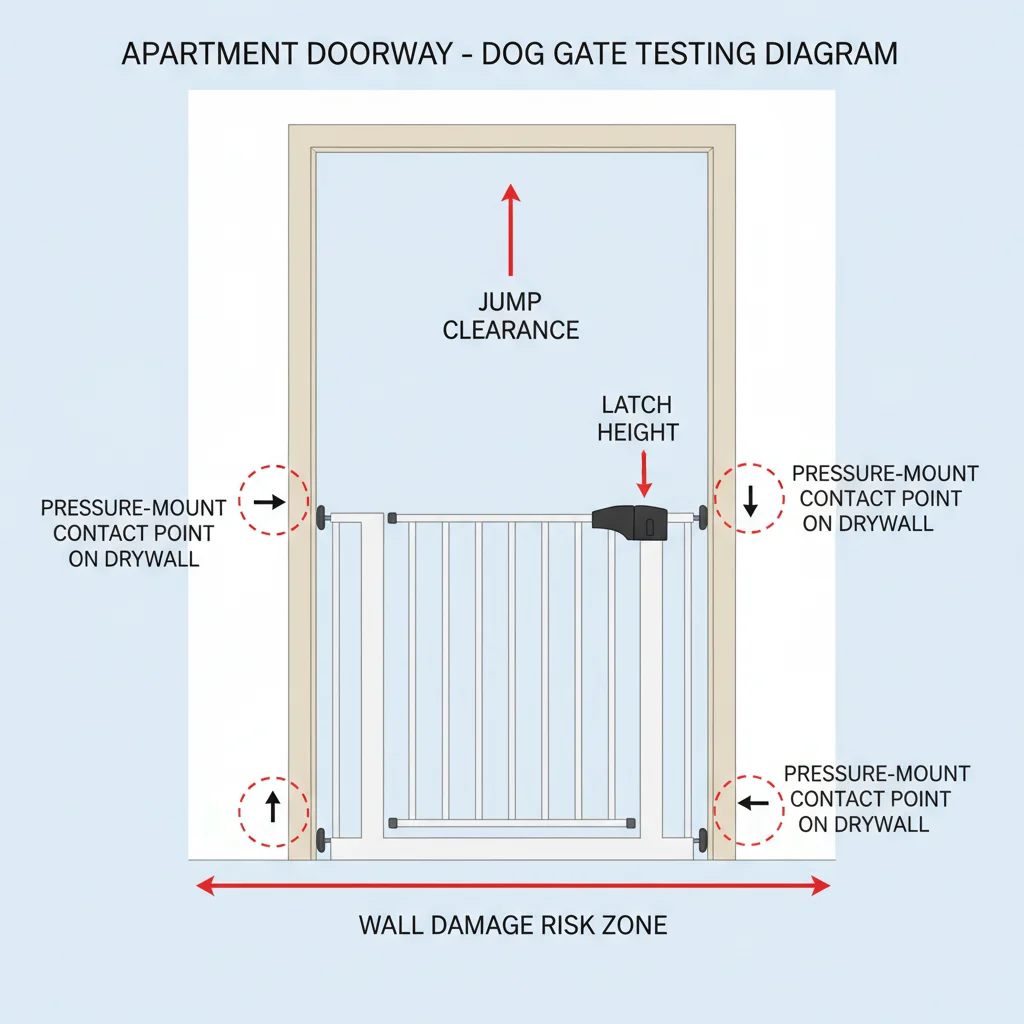
Clone listicles sort by Amazon stars and call every 36-inch panel extra-tall. We sort by three numbers you can check in the doorway you actually have: clearance above the dog’s jump line, latch height and side, and how the mount treats drywall after months of load.
We do not lab-test every SKU in a warehouse. We score product classes against apartment jobs: hallway jumpers, stair tops, and front-door dashes. Brand names below are class examples, not lifetime warranties.
- Jump class: 36-inch, 41-inch, or 54–55-inch panel, plus whether the dog gets a running start.
- Latch class: one-hand walk-through, two-hand adult latch, or hardware you cannot paddle with a muzzle.
- Mount class: pressure cups on painted drywall versus screws into trim or a kit that you can patch.
Measured clearance vs shoulder height
Measure the dog at the withers, then watch the jump, not the standing pose. Athletic herding mixes and sighthound mixes clear a rail well above shoulder height when the hallway gives them three strides. Furniture and shoe racks next to the gate are launch pads. Move them before you blame the inch count.
36–36.5 inches is the Carlson Extra Tall / many “pet gate” walk-throughs. That class beats toddlers and casual nosers. It loses to a 40-pound leaper who already practiced on the last gate. 41 inches is the first extra-tall class that stops dogs who hop 36-inch rails without a sprint. 54–55 inches is the jumper class when the dog still clears 41.
Width matters because flex matters. A 55-inch-tall pressure span in a 32-inch hallway is a different machine than the same SKU stretched across a wide living-room opening with extensions. Extensions add height on paper and wobble in real doorways. Measure the opening at the floor and at 40 inches up. Apartment frames are rarely square.
Latch side and one-hand walk-through
Door-dash timing beats height alone—latch geometry kids can reach is not dog-proof. A walk-through in the middle of a 36-inch panel puts the paddle where a tall dog’s nose already lives. You need a latch you can close with a leash in one hand and a grocery bag in the other, above muzzle height, that the dog cannot rake.
Note which side the walk-through sits on relative to the apartment door swing. A latch jammed against a door that opens into the gate is how people start leaving the gate open “just for a second.” That second is the dash. Offset the walk-through so your exit hand meets the latch without stepping into the dog’s lane.
- One-hand close you can do without looking down.
- Latch above the dog’s standing muzzle, not at mid-panel on a 36-inch gate.
- No auto-open if the dog can body-slam the door while you fumble keys.
12-month pressure-mount frame wear
Pressure mounts that walk off the frame after month six leave drywall dimples renters notice at move-out. The cups do not fail on day two. They fail after humidity, a summer slam, and the 200th walk-through. Flattened rubber, a spindle you keep retightening, and a grey oval on the paint are the tell.
We treat 12-month wall damage as a spec, not a complaint. Hardware screws leave holes you can fill. Walking pressure cups grind a larger, uglier patch into the same drywall. Photograph the doorway before install. That photo is the deposit argument.
Best extra-tall gates for apartment jumpers
Here is the shortlist by class, not by who paid for a “best of 2026” badge. If your dog already cleared 36 inches, skip the first row. If the failure is a dash through an open walk-through, skip down to latch and front-door setup.
- 54–55 inch extra-tall pressure class (Regalo 54-inch Extra Tall and clones) — hallway jumpers who still hop 41-inch rails.
- 41-inch walk-through extra-tall class (Regalo Easy Step Extra Tall 41-inch class) — dogs who hop 36-inch Carlson-class gates without a sprint.
- Hardware extra-tall class (Cardinal Gates Extra Tall / similar screw-mount wood or steel) — stair tops and door-dashers who slam the panel.
- Retractable hardware mesh (Retract-A-Gate class) — wide or awkward openings where a rigid extra-tall frame will not square.
- Not a jumper gate: 29–36.5 inch baby and “pet extra-tall” walk-throughs, including Carlson Extra Tall 36-inch class, once you have a jump video.
41-inch vs 55-inch class
41 inches is the honest upgrade from a 36-inch Carlson-class walk-through. It stops many apartment dogs who treat 36 inches as a hurdle they learned. It does not stop a running leaper with furniture as a step. If the dog still clears 41, do not buy a second 41-inch colorway. Step to 54–55 inches or stop using a gate as the plan.
54–55 inch pressure gates look cartoonish in a studio. They are the correct height class for large, athletic jumpers. They still lose if the mount walks, if extensions turn the span into a trampoline, or if a pet-door insert is a second opening. Height without a seated mount is a sail.
| Height class | Typical SKUs | Who it actually holds | Who still clears it |
|---|---|---|---|
| 29–32 inch | Most baby gates, décor wood pressure gates | Toddlers, small nosers | Almost any athletic adult dog |
| 36–36.5 inch | Carlson Extra Tall walk-through class | Casual hoppers, many medium dogs without a run-up | 40 lb leapers in a hallway with three strides |
| 41 inch | Regalo Extra Tall 41-inch walk-through class | Dogs who already beat 36-inch rails | Running jumpers and dogs using furniture as a step |
| 54–55 inch | Regalo 54-inch Extra Tall and similar | Most apartment jumpers if the mount stays put | Climbers using the walk-through as a ladder; slam-dashers if the latch is mid-panel |
| Hardware extra-tall (~38 inch+) | Cardinal Extra Tall, retractable hardware mesh | Dashers who slam; stair tops where pressure walks | High jumpers if the panel is still only ~38 inches |
Read the row, not the Amazon title. “Extra tall” on a Carlson-class listing means taller than 29 inches. It does not mean jumper-proof.
Walk-through vs step-over
Walk-throughs win in apartments because you will not high-step a 41-inch rail 12 times a day with laundry. They lose when the door is the latch the dog already opened. Step-over extra-tall panels remove that hinge, then they become furniture you trip over at 6 a.m. If you pick walk-through, budget latch class as a separate line item from height class.
Auto-close hinges help only if they actually close against a dog in the opening. Many pressure walk-throughs bounce open if you hip-check them with bags. Test that with a full grocery load, not an empty doorway photo.
Pet-door insert risk
Small swinging pet doors in extra-tall gates are a mixed-size feature, not a jumper feature. A terrier insert under a 41-inch panel is how the jumper gets a foothold, or how the “contained” dog leaves anyway. If you have one athletic dog, buy a solid panel. If you have a jumper plus a tiny dog who must pass, the insert has to be physically impossible for the jumper—muzzle and shoulders, not hope.
Inserts also add a second latch. Second latches get left open. That is an ownership failure, not a brand failure. Count openings the way you count crate doors.
Pressure-mounted vs hardware-mounted for real leapers
Pressure is the rental default because listings say “no drill.” Jumpers and door-dashers are a load case those listings never mention. Hardware is the default when the dog slams, the opening is a stair, or you already replaced one walked-off frame.
The brand-level SKU fight—Regalo extra-tall vs Carlson walk-through vs 55-inch pressure spans—belongs on a comparison page. This hub only decides mount class so you do not buy height on a mount that will not stay.
When pressure fails
Pressure fails in three ways. The cups walk and the whole gate becomes a hurdle on the floor. The span flexes in the middle so a 55-inch panel is 55 inches only at the walls. The walk-through rackets until the latch no longer seats. All three show up after months, which is why unboxing reviews look fine.
A 40-pound leaper hitting the top rail is a different load than a toddler leaning. If your dog body-slams, treat pressure as a temporary hallway tool, not a front-door tool. Retighten on a schedule. If you retighten weekly by month four, the mount class is already wrong.
- Hallway, light jumper, square opening, no slam: pressure extra-tall can work if you recinch.
- Stair top, rental or not: hardware. A walked-off pressure gate on stairs is a fall, not a scuff.
- Front door with dashes: hardware or a double-gate airlock. Pressure walk-throughs lose the timing war.
Rental-friendly hardware options
Hardware is not automatically a lost deposit. Screws into wood or metal trim, or into a removable mounting kit, patch cleaner than four ground-in pressure ovals. Ask the landlord in writing. Photograph the paint. Use the smallest honest screw that holds, not lag bolts into hollow drywall.
Retractable hardware mesh (Retract-A-Gate class) hangs from a cassette. It needs a solid attach point but stores off the opening, which helps delivery days. Mesh is not a chew toy. If the dog attacks fabric, this class is wrong. Cardinal-style wood or steel extra-tall hardware is the slam class.
If you cannot drill at all, you still cannot pretend pressure is hardware. Use pressure extra-tall only in a hallway, recinch, and put a real barrier—closed door plus crate—on the exit that matters. Our escape-proof apartment crate shortlist is the backup when a gate is the wrong machine.
Stair vs hallway vs front door
Hallways are pressure’s best job: square-ish paint, no stair drop, guests rare. Stair tops are hardware’s job even if the dog is not a jumper; gravity punishes a walked cup. Front doors are a timing job. Height without an airlock still loses if the dog can see the corridor when the deadbolt turns.
Do not copy a baby-gate stair install photo for a jumper. Those photos assume a 29-inch panel and a toddler who cannot leap a newel post. Your dog can. Measure the triangle at the banister. Hardware gates that follow the angle beat a pressure rectangle that leaves a jump window at the rail.
Door-dasher setups at the apartment entry
Door-dashers are not jumpers with a different hobby. They win in the second the deadbolt turns. A 55-inch gate left open while you sign for a package is a 0-inch gate. Setup beats SKU here.
If the dog only bolts at the front door and never jumps a hallway rail, extra-tall is optional. Latch, swing, and a second barrier matter more. If they do both, you need height and an airlock, not a taller version of the gate you already leave open.
Latch height vs bolt timing
Stand in the entry with keys, leash, and a bag. Watch where your hand goes. If the walk-through latch is behind the door swing, you will open the apartment door first. The dog reads that order. Flip it: gate latched until the apartment door is a slit, then you step through the gate into a vestibule the dog cannot enter.
Latch height should sit above the standing muzzle and on the side of your free hand. Kids in the home need a different conversation: a latch they can open is also a latch the dog can learn by watching. Two-stage adult latches exist for a reason. Use them if a child lives there, and still train the humans. Hardware does not replace a closed-door rule.
Double-gate airlocks
Two gates, or a gate plus the apartment door used as a gate, make a one-body airlock. You step in, close one, then open the other. Couriers and guests hate it until they meet the dog in the hallway. In a tight entry, the second gate often sits at the hall corner, not stacked on the same frame.
Airlocks fail when one gate is a 29-inch décor panel the dog jumps while you operate the tall one. Both barriers need to match the dog’s jump class, or the inner one needs to be a solid door. Do not mix a jumper-height outer gate with a baby-height inner gate and call it strategy.
Delivery and guest traffic
Apartment life is doorbells. A walk-through you can run one-handed with a leash parked on a hook next to the latch is the only humane design. If every delivery means unclipping a pressure gate from the wall, you will stop using it. That is how 55-inch gates end up in the closet.
Guests need a one-sentence script: wait, latch, then enter. Put the script on a note if your building has rotating cleaners. A gate nobody else can operate is a gate that stays open. Retractable hardware helps here because you can open the full span for furniture days without unscrewing cups.
If the dash is panic, not opportunism, a taller gate is not a behavior plan. Use confinement only if a veterinarian or qualified professional says it fits. A camera on the entry is part of diagnosis, not a gadget. See our notes on a dog camera for separation anxiety if the bolt only happens after you leave or at the door in a panic spiral.
12–18 month ownership: walk-off, wall marks, and latch wear
Unboxing is not ownership. Jumpers load the top rail. Dashers load the latch. Humidity in a walk-up loads the cups. Twelve months is when Amazon photos stop matching the doorway.
Budget recinching, replacement pads, and a patch kit the way crate buyers budget trays. If that sounds like too much work, you wanted hardware from the start.
Drywall dimples
Pressure cups crush paint into grey ovals. On cheap rental drywall they go further: a dent you see in afternoon light. Touch-up paint does not fill a dent. You need spackle, sand, prime, paint, and a landlord who accepts the story. Hardware screw holes are smaller and honest.
Put furniture sliders or manufacturer wall cups on the contact points from day one. They still mark. They mark less than bare plastic grinding for a year. Recheck after week four, when the first walk shows up, not after the gate is on the floor.
Frame flex
Extra-tall pressure frames flex in the middle. You see it when the walk-through no longer lines up with the latch post. You hear it when the panel drums on a body slam. Neighbors in thin buildings hear it too. A dense rug runner under the dog’s launch path helps more than a “quiet gate” listing.
Extensions make flex worse. If your opening needs more than one extension, you are in retractable-hardware or custom-span territory. A 55-inch-tall gate that is also over-extended is two marketing numbers stacked on a weak rectangle.
Metal walk-through hinges develop play. Plastic housings crack at the spindle. That is retirement, not a glue job. Latch geometry on gates is the same story as crate latches: play means the dog already has a new puzzle. If you want the failure-mode mindset, our notes on crate latch failure modes translate cleanly to gate paddles.
When to retire a gate
Retire when the cups will not hold a recinch, when the walk-through racks, when the dog has a jump video over the current height, or when drywall damage is cheaper to stop than to patch later. Do not “size up” from 36 to 36.5. Change height class or mount class.
Retire to a closed door and a crate if the dog is injuring itself on the gate. A taller panel is still a hurdle. Welfare beats containment theater. Long-term hardware wear in apartments is the same curve we track on 12–18 month crate wear: rust, play, and neighbor noise show up after the review window closes.
What we skipped (and why)
The SERP is Amazon keyword pages, Wayfair category walls, and short affiliate listicles that treat every indoor gate as the same SKU with a different photo. We skipped that pile on purpose.
Baby-gate roundups
29–32 inch décor gates, pressure-mounted wood with a one-hand adult latch, and “best baby gates that also work for pets” lists are toddler tools. They lose to jumpers. Including them as “budget picks” is how readers buy a second gate in a week. We do not list them as jumper options.
Playpen and crate lists
Playpens and crates are different jobs. A playpen is an island. A crate is a den with a door class. A gate is a doorway. Mixing the three in one listicle is how 36-inch gates sit next to MidWest pens as if they solved the same hallway. Playpens belong in a different job: an island, not a doorway. For Houdini doors, use the crate shortlist linked above, including the Midwest iCrate vs escape-proof crate notes when the “gate” you actually need is a framed door. This page stays on doorway barriers.
Spec sheets with no mount context
A table that lists height and Amazon price without mount class, latch height, and 12-month wall notes is a shopping-ad clone. Artemis Paw and similar jumper posts name extra-tall SKUs and skip drywall, pet-door inserts, and door-dash timing. We would rather name four classes with those specs than ten SKUs without them.
We also skipped outdoor driveway gates, farm panels, and 72-inch commercial doors. They do not fit a rental hallway. If your dog needs that class of barrier, you need a different living setup, not a longer Amazon query.
Frequently Asked Questions
Is a 36-inch extra-tall gate enough for a jumper?
Usually not for an athletic 40-pound dog in a narrow hallway. 36–36.5 inch Carlson-class gates are extra-tall versus baby gates, not versus leapers. Start at 41 inches only if the dog hops a 36-inch rail and cannot get a running start. True jumpers belong in the 54–55 inch class, or behind a closed door and a different plan.
Do pressure-mounted gates hold dogs that jump or slam?
They hold until the cups walk. A leaper loads the top rail; a dasher loads the latch. After six to twelve months, flattened pads and drywall dimples are common in rentals. Hardware-mounted extra-tall gates stay put if the screws hit something real. Pressure is a hallway convenience, not a slam spec.
What latch height stops a door-dasher?
Height of the panel is not the latch. Door-dash timing beats height alone—latch geometry kids can reach is not dog-proof. You need a walk-through latch you operate one-handed above muzzle height, that the dog cannot paddle, and that closes without a second look. If the latch sits in the middle of a 36-inch panel, a tall dog can work it.
Are pet-door inserts a problem in extra-tall gates?
Yes, if the dog you are containing can also fit the insert, or if a jumper uses the insert as a foothold. Small-dog pass-throughs belong in mixed-size homes only when the jumper physically cannot use them. For a single athletic dog, a solid extra-tall panel without a flap is simpler.
Can I install a hardware-mounted gate in a rental apartment?
Often yes, with written permission and a patch plan. Tension cups leave dimples too; they are not damage-free. Narrow wood or metal trim, or a removable mounting kit on a painted frame, is easier to restore than four pressure cups ground into drywall for a year. Photograph the doorway before you drill.
Your next step
Watch the video of the last failure. If it is a jump, buy a higher height class, not another 36-inch “extra-tall” clone. If it is a dash, fix latch side and airlock before you shop inches. If the cups already walked, change mount class.
Tape the opening, including swing. Recinch pressure gates at week four. Photograph the paint. That is the apartment spec sheet. Stars on a baby-gate listicle are not.