Shoppers comparing a pressure mounted vs hardware mounted dog gate after a hallway leap usually already own the “no-drill extra-tall” that walked an inch off the paint. The listing sold convenience. The dog sold a physics problem: top-rail load versus four rubber cups on rental drywall.
Renters default to pressure mounts; jumpers often defeat them by month three. That is not a brand scandal. It is what happens when a 40-pound leaper treats the top bar like a hurdle and the cups treat the wall like a suggestion.
This page is the mount-class comparison, not another 36-inch baby-gate roundup. Height still matters, and we send you to a shortlist when inches are the open question. Here the job is stay-put versus walk-off, screw holes versus dimples, and which doorway in an apartment actually deserves a drill.
When pressure mounts fail for 40+ lb leapers
Pressure is a clamp. Clamps hold until the surface yields or the spindle backs off. A toddler leaning on a 29-inch décor gate is a light, low load. A 40-pound athletic mix hitting the top rail of a 41- or 55-inch panel is a high, short load. The cups see that as a wedge. The paint sees it as a dent in progress.
Unboxing reviews look fine because walk-off is a months problem. Humidity in a walk-up, summer slam sessions, and the 200th one-hand close all loosen the same four contact points. If you recinch weekly by month four, the mount class is already wrong. Buying a second pressure SKU in a different color is the same purchase.
- Hoppers (clear a 36-inch rail without a sprint, no body slam): extra-tall pressure can work in a square hallway if you recinch on a schedule.
- Leapers (video of a clean jump, furniture as a step): pressure is a temporary hallway tool. Hardware or a closed door is the plan.
- Slam-dashers (hit the panel when the latch opens): pressure walk-throughs lose the timing war even if height is honest.
Frame flex and walk-off
Walk-off is the cups creeping. Flex is the middle of the panel becoming a trampoline while the cups still look seated. Extra-tall pressure frames show both. You see flex when the walk-through door no longer lines up with the latch post. You hear it when the panel drums on a body slam. Neighbors in thin buildings hear it too.
A 55-inch-tall pressure span in a 32-inch hallway is a different machine than the same SKU stretched across a living-room opening with extensions. Extensions add width on the box and wobble in real doorways. Measure the opening at the floor and at 40 inches up. Apartment frames are rarely square, which is how one cup rides on paint while the opposite cup rides on a baseboard gap.
Flattened rubber, a spindle you keep retightening, and a grey oval on the paint are the tell. Wall-saver discs spread the oval. They do not convert a clamp into a screw. If the dog already has a jump video over the current height, recinching is not a height upgrade.
Tile vs carpet contact
Bottom contact is the forgotten spec. On carpet, the bottom rail sinks and the top cups unload. On tile or vinyl, the feet skate unless the manufacturer designed a no-slip pad that actually stays stuck after mopping. Many extra-tall pressure gates assume a painted drywall sandwich at chest height and a clean floor. Studio apartments give you a radiator, a shoe pile, and a baseboard heater instead.
If one cup lands on tile trim and the opposite cup lands on painted drywall, the clamp is diagonal. Diagonal clamps walk faster. Shim with manufacturer cups, not stacked cardboard. Cardboard compresses, then you blame the brand.
- Carpet plus jumper: expect the bottom to bury and the top to loosen. Recheck week two.
- Hard floor plus jumper: expect skate unless pads are new and the opening is square.
- Mixed floor (tile hall, carpet room): do not span the transition with one pressure gate.
Extra-tall pressure span limits
Extra-tall is a height class, not a stay-put class. A 54–55 inch pressure gate can stop a leaper who already cleared 41 inches—if the cups stay and the span does not flex. That “if” is why mount type belongs on this page and SKU inches belong on a shortlist.
Wide openings need retractable hardware mesh or a true hardware panel, not three pressure extensions stacked into a sail. Narrow openings still fail if the walk-through sits in the dog’s muzzle line. Height without a seated mount is a tall hurdle you paid to install twice.
Renters default to pressure mounts; jumpers often defeat them by month three.
When the failure is a dash through an open walk-through, you did not have a height problem. You had a latch-and-timing problem. Fix that before you shop another extra-tall clamp.
Side-by-side: install time, reversibility, and jump load
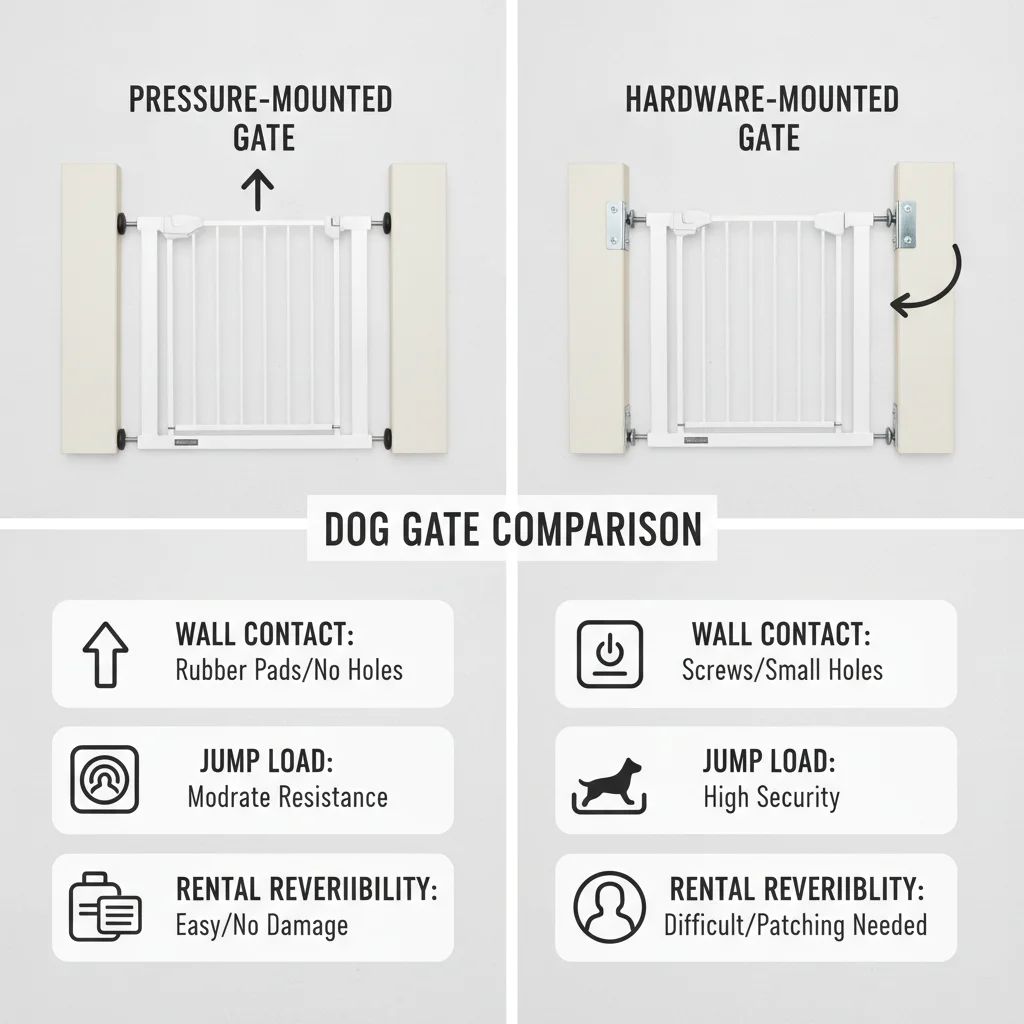
Mount type is not a feature checkbox—it is a physics choice for jumpers. Pressure wins the unboxing clock. Hardware wins the 12-month doorway. Reversibility is the rental argument people get backwards: cups look removable and then grind a larger patch than three honest screw holes in trim.
| Spec | Pressure-mounted extra-tall | Hardware-mounted extra-tall |
|---|---|---|
| Install time | 10–20 minutes if the opening is square | 30–60 minutes plus a stud or solid trim finder |
| Jump load path | Top rail into four cups on paint | Frame into screws; load spreads into wood or kit |
| Walk-off risk (40+ lb leaper) | High by months 2–6 | Low if screws hit something real |
| 12-month wall | Grey ovals, dimples, sometimes torn paper | Small holes you fill; trim scars if you miss the wood |
| Rental reverse | Looks easy; patch is a dent, not a hole | Looks scary; patch is spackle if you planned it |
| Stair top | Wrong class; a walked gate is a fall | Default class, plus a banister adapter if the triangle is open |
| Front-door dash | Loses on latch timing even when height is honest | Wins stay-put; still needs airlock and latch side |
| Best job | Square hallway, hopper not slammer, recinch habit | Slam, stair, jumper with video, any opening that is not square |
Read the row that matches the last failure, not the Amazon title that says “no tools.” Tools are 20 minutes. A walked 55-inch panel in a stair opening is an injury report.
Drywall dimples vs screw holes
Pressure cups crush paint into grey ovals. On cheap rental drywall they go further: a dent you see in afternoon light. Touch-up paint does not fill a dent. You need spackle, sand, prime, and a landlord who accepts the story. Hardware screw holes are smaller and honest when they sit in wood or metal trim.
Hardware into hollow drywall with no anchor plan is the worst of both: weak hold plus ugly holes. That is not an argument for pressure. That is an argument for finding the trim, a removable kit, or a different doorway. Photograph the paint before either mount. That photo is the deposit argument.
Walk-through latch comparison
Both mount classes sell walk-through doors because apartments are laundry, not show homes. The latch is a separate spec. A mid-panel paddle on a 36-inch gate sits at muzzle height for a tall dog. A two-hand adult latch on a hardware extra-tall panel still fails if you leave it open to sign for a package.
Pressure walk-throughs often bounce if you hip-check them with bags. Hardware walk-throughs slam louder in thin buildings unless the closer is real. Test with a full grocery load. Note which side the walk-through sits on relative to the apartment door swing. A latch jammed against a door that opens into the gate is how people start leaving the gate open “just for a second.”
- One-hand close you can do without looking down.
- Latch above standing muzzle, not at mid-panel on a short gate.
- No auto-open if the dog body-slams while you fumble keys.
Stair banister adapters
Stair tops are hardware’s job even if the dog is not a jumper. Gravity punishes a walked cup. Banister triangles are the jump window baby-gate photos ignore. Hardware gates that follow the angle beat a pressure rectangle that leaves a gap at the rail.
Adapters that clamp a newel post without chewing it exist. They still need a patch story if they scuff finish. Measure the triangle. If the dog can get a paw on the rail, extra height on a pressure rectangle will not close that window. Same doorway can need hardware at the bottom and extra height at the top.
Rental-friendly hardware without losing containment
Hardware is not automatically a lost deposit. Screws into wood or metal trim, or into a removable mounting kit, patch cleaner than four ground-in pressure ovals after a year of jumper load. Hardware spreads load but lease language varies—patch kits matter as much as SKU choice.
Ask in writing. Name the doorway. Offer to restore. Landlords who refuse all holes sometimes still accept a kit on painted trim they already planned to repaint. Landlords who say “use a pressure gate” have not watched your jump video. Send the video. Send the dimple photo from the last gate. That is a better argument than a SKU link.
Removable kits
Removable hardware kits put a bracket on the wall and a gate that lifts off. You still drill. You drill once into something solid. You do not grind four cups for twelve months. For jumpers, the kit only counts if the gate cannot lift off from the dog side. A decorative lift-off that a 40-pound mix can rake is a hinge, not a mount.
Retractable hardware mesh (Retract-A-Gate class) hangs from a cassette. It needs a solid attach point and stores off the opening, which helps delivery days and furniture moves. Mesh is not a chew toy. If the dog attacks fabric, this class is wrong. Cardinal-style wood or steel extra-tall hardware is the slam class. Height still has to match the jump, not the baby-gate aisle.
Patch and paint expectations
Budget a small tub of spackle, a sanding sponge, primer, and the landlord’s paint code the day you buy the gate. That kit is cheaper than arguing at move-out. Pressure ovals need filler because they are dents. Screw holes need filler because they are holes. Dents photograph worse in afternoon light.
Do not use lag bolts into hollow drywall “to be sure.” Use the smallest honest fastener that holds in real wood, metal, or a rated anchor in a known substrate. Over-hardware is how renters turn a restorable install into a repair bill. Under-hardware is how the gate becomes a projectile. Hit something real or pick a different opening.
Landlord disclosure
Disclose before the first hole. “Pet gate” in a lease often means they imagined a 29-inch pressure panel, not a 55-inch jumper install. State mount type, height class, and that you will restore. If they refuse hardware and your dog already walks pressure, you do not have a shopping problem. You have a closed-door plus crate problem for the doorway that matters.
A gate is a doorway tool. When the doorway cannot take the mount the dog requires, the backup is a framed door, not a third clamp. Our escape-proof apartment crate shortlist is the machine you want when the “gate” is actually a den with a latch class. If the current crate is a slide-bolt iCrate the dog already opened, the Midwest iCrate vs escape-proof crate notes apply the same stay-put logic to doors instead of cups.
Hybrid setups renters actually use
Hybrids show up in renter forums because people try to keep the no-drill listing and add “just a couple of screws.” Stacking mount classes on one frame usually adds flex and a second failure point. The useful hybrids are two jobs, not one franken-gate: a hardware extra-tall at the stair, a recinched pressure extra-tall in a square hall, a closed apartment door as the third barrier at the entry.
Do not mix a jumper-height outer gate with a baby-height inner gate and call it strategy. The dog will pick the short one. Both barriers need to match jump class, or the inner one needs to be a solid door.
Pressure top + hardware bottom myths
Same doorway can need hardware at the bottom and extra height at the top. That sentence describes a hardware extra-tall panel with a solid bottom rail, not a pressure bar lashed to a screw kit. A pressure spindle at the top still walks when the dog hits the rail. Screws at the floor do not save a clamp at 50 inches.
People invent this stack when the landlord allowed two screws “at the baseboard only.” Two screws at the baseboard plus a 55-inch sail is a lever. Levers pry paint. If you only get permission for low fasteners, you still need a full-height hardware frame designed for that, or you need a different doorway.
Freestanding vs fixed
Freestanding extra-wide “gates” and playpen panels are islands. Jumpers treat them as furniture. Door-dashers go around. They belong in a different job: a pen, not a doorway. A doorway needs a fixed span to the frame, either clamp or screw. If the product stands on feet with no wall contract, it is not in this comparison.
Some renters put a freestanding panel in front of a pressure gate as a “second layer.” The dog uses the first as a step. Remove launch pads—shoe racks, radiators with covers, the armchair you parked “just for plants”—before you blame inches or mount type.
Pet-door insert compromises
Small swinging inserts in extra-tall gates are a mixed-size feature, not a jumper feature. A terrier flap under a 41-inch panel is a foothold or a second exit. For one athletic dog, buy a solid panel. For a jumper plus a tiny dog, the insert has to be physically impossible for the jumper—shoulders and muzzle, not hope.
Inserts also add a second latch. Second latches get left open. Count openings the way you count crate doors. Hardware versus pressure does not rescue a flap the contained dog can use. If you need a pass-through, it is a layout decision, not a mount-type upgrade.
Our pick by scenario
Pick the doorway job first. Then pick mount class. Then pick height class. Reversing that order is how 36-inch “extra-tall” clones multiply in closets. Brand names below are class examples, not warranties. We do not lab-test every SKU in a warehouse. We score load path against apartment jobs.
Front-door dasher
Door-dashers win in the second the deadbolt turns. Height without an airlock still loses if the dog can see the corridor. Hardware extra-tall (Cardinal-class wood or steel, or retractable hardware mesh if the opening is awkward) so the panel does not walk when slammed. Latch on the free-hand side, above muzzle height. Second barrier: hall-corner gate or the apartment door used as a one-body airlock.
Pressure walk-throughs lose here even when they are 55 inches tall. You will unclip them for groceries. A gate you unclip is a 0-inch gate. If the dash is panic, not opportunism, a taller mount is not a behavior plan. Use confinement only if a veterinarian or qualified professional says it fits.
Hallway airlock
Square painted hallway, guests rare, dog hops rather than slams: extra-tall pressure can be the inner gate of an airlock if you recinch at week four and month three. The outer barrier at the entry should still be hardware or a closed door. Do not run two pressure gates in series and call it hardware-grade.
If the hallway is the only containment and the dog already walked a 41-inch clamp, skip the third pressure SKU. Step to hardware extra-tall in that same opening, or stop using a gate as the plan. Width plus extensions is the usual failure. If you need more than one extension, you wanted retractable hardware or a different span.
Stair top only
Hardware. Every time. A walked pressure gate on stairs is a fall, not a scuff. Follow the banister triangle. Extra height on a rectangle that leaves a rail gap is still a jump window. Photograph the finish. Use a newel adapter that you can restore. Recinch is not a stair strategy.
If the dog also clears 41 inches in the hall, the stair gate still needs jumper height. Hardware without height is a firmly attached 38-inch hurdle. Mount class and height class stay separate line items on the same receipt.
Frequently Asked Questions
Will a pressure-mounted extra-tall gate hold a 40-pound jumper?
Sometimes in a square hallway, for a few months, if the dog hops rather than slams. A 40-pound leaper loads the top rail and walks the cups. By month three many renters are recinching weekly. Hardware is the mount class once you have a jump video plus a walked frame.
Is hardware-mounted always better for jumpers?
It is better at staying put. It is not automatically tall enough. A 38-inch hardware gate still loses to a dog who already cleared 41-inch pressure rails. Pick height class and mount class separately. Hardware without height is a firmly attached hurdle.
Can I install a hardware dog gate in a rental without losing the deposit?
Often yes, with written permission, photos, and a patch kit. Four pressure cups ground into drywall for a year leave larger, uglier marks than a few screw holes in trim. Hardware spreads load but lease language varies—patch kits matter as much as SKU choice.
Do wall-saver cups stop pressure-gate damage?
They spread the dent. They do not stop walk-off on a jumper. After humidity and the 200th slam, you still get grey ovals and a spindle you keep tightening. Treat cups as damage reduction, not as a hardware substitute.
Should I combine pressure and hardware on the same doorway?
Same doorway can need hardware at the bottom and extra height at the top—but that means a hardware extra-tall panel, not a pressure bar stacked on screws. Stacking two mount classes on one frame usually adds flex and a second latch to leave open.
Your next step
Watch the last failure. If the cups walked, change mount class, not colorway. If the jump cleared the rail, change height class after the mount can stay. If the dash went through an open walk-through, fix latch side and airlock before you shop inches.
Tape the opening, including swing. Photograph the paint. Recinch any remaining pressure gate at week four. Ask for hardware in writing on the doorway that would injure someone if it walked. Stars on a no-drill listicle are not a rental spec sheet.