People shopping a dog gate for door dashers usually already own a walk-through that looks fine in photos and fails in the second the deadbolt turns. Height was the Amazon filter. Timing is the actual job: keys in one hand, leash in the other, dog already committed to the gap.
The bolt happens in the second the deadbolt turns—height alone does not fix timing. If the video shows a clean jump over a closed panel, you still have a height-class problem. If the video shows a blur through an open paddle, shopping another extra-tall clone is the same purchase with a different color.
This page is the apartment entry setup, not a baby-gate roundup. We map swing, latch side, and leash hand first. Then we pick a single barrier versus a two-gate airlock, and only then name product classes. When a gate is the wrong machine for an exit, we say so and point at a crate.
Map the dash: door swing, latch side, and leash hand
Tape the doorway before you open a listing. Mark where the apartment door sits at 45 degrees and at 90 degrees. Mark which hand holds the leash when you enter. Mark where the dog stands during that ritual. Those three marks beat any “best gate 2026” table.
Narrow entryways force offset mounts that listicles never diagram. A 32-inch hall with a radiator, a shoe rack, and an inward-swing door is a different machine than a suburban foyer. If the panel will sit in the door’s arc, you will start leaving the gate open “just this once.” That once is the dash.
- Outbound dash: you leave; dog reads keys and coat as a cue; gap is the walk-through you did not close.
- Inbound dash: you enter with bags; dog hits the open panel; pressure cups take a body slam.
- Guest dash: someone else operates a latch they have never used; dog already knows the delay.
Inbound vs outbound triggers
Outbound is a cue stack: keys, shoes, elevator voices in the hall. The dog does not need a running start if you stand inside the gate and swing the walk-through toward the apartment door. You just built a funnel. Close the walk-through first, then the deadbolt, or reverse the order on purpose and keep it every time.
Inbound is worse for pressure mounts. You are loaded, the dog is excited, and the slam hits the top rail. Recinching after every grocery run is how people decide the brand is defective. The brand sold a clamp. You asked it to be a crash barrier.
Film one week of entries from the dog’s side. If the failure is a jump over a closed rail, change height class. If the failure is a body through an open door, change layout and latch, not inches.
Guest and delivery patterns
Delivery and guest traffic need a walk-through latch you can operate one-handed with a leash. Guests will not learn your two-hand adult latch under a pizza box. If you expect weekly deliveries, the outer barrier should be a closed apartment door plus a gate they never touch, or a latch so obvious they cannot leave it open.
Building hallways add a second audience: neighbors, kids, and the person who props your door. An airlock gives you a buffer so a propped building door is not an open apartment. The inner gate is for the dog. The outer plane is the unit door. Mixing those jobs onto one 36-inch paddle is how dashers win.
- Note which days have grocery bags versus a free hand.
- Note whether kids open the walk-through from inside while you talk in the hall.
- Note whether the dog only dashes for guests. That is a training-plus-layout problem, not a SKU problem.
Kids vs dog latch confusion
A latch a child can paddle is a latch a muzzle can rake. Mid-panel walk-throughs on 36-inch gates sit in both strike zones. Raise the adult latch above standing muzzle height, or pick hardware kids cannot open and give children a different path—usually the interior door you actually close.
Do not run two competing rules. “Kids may open the gate” plus “dog may never open the gate” fails at 6 p.m. when everyone is tired. One opening, one operator class. If that is impossible, the front door is a closed-door job and the gate belongs deeper in the apartment.
Layouts that work in tight apartment entries
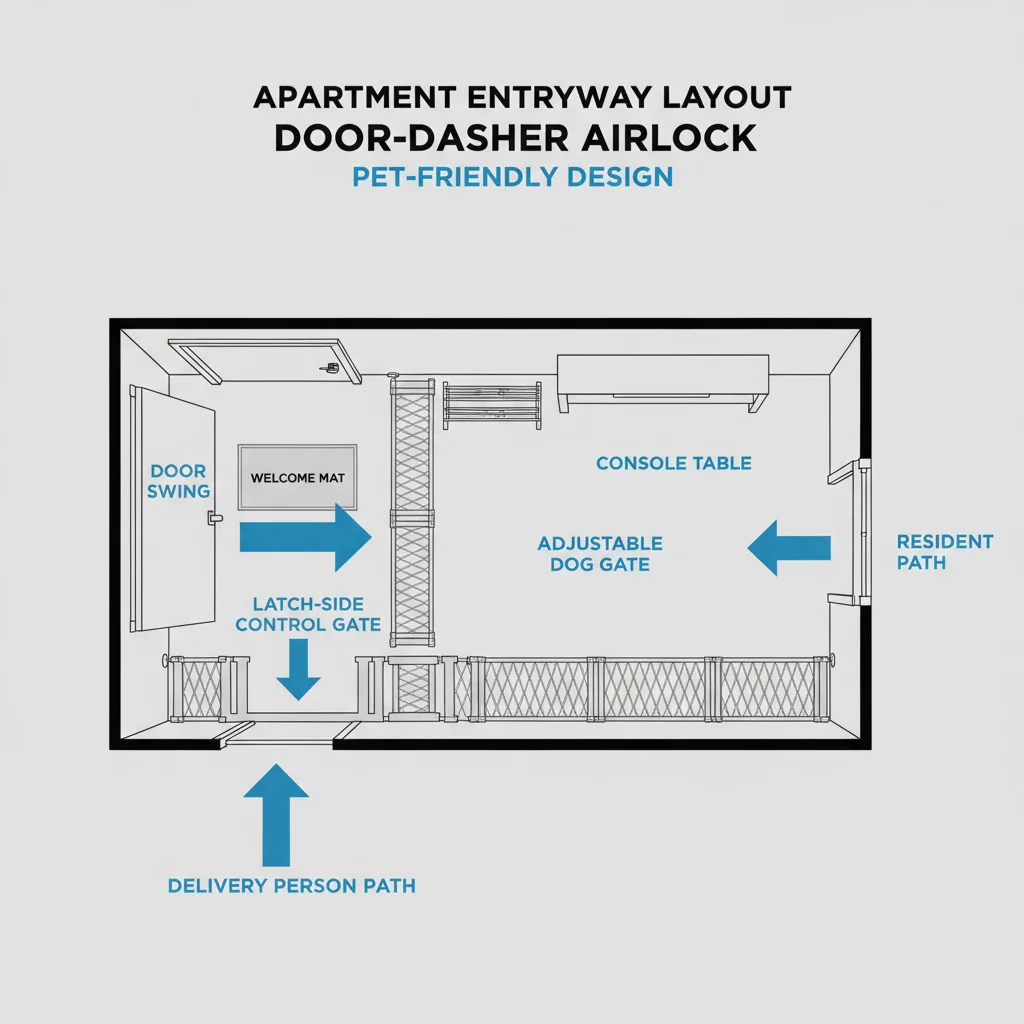
Door-dasher control is geometry, not brand loyalty. The three layouts that show up in real rentals are a single extra-tall panel, a two-gate airlock, and an offset pressure span that clears the door swing. Pick by swing and slam, not by Amazon stars.
| Layout | Best when | Fails when |
|---|---|---|
| Single extra-tall walk-through | Square hall, dog hops more than slams, you have a free hand | Door swings into the panel; inbound slams; kids share the paddle |
| Two-gate airlock | Dasher plus deliveries; you need a buffer while the unit door is open | Both gates are pressure clones you leave open; width needs two extensions |
| Offset mount / closed unit door | Swing collides with any panel; you cannot drill; dog is a leaper | You insist on a gate in a 24-inch vestibule that has no buffer |
Single extra-tall barrier
A single panel works when the dog cannot reach a sprint, the walk-through sits on your leash-hand side, and the apartment door can open without hitting the frame. Measure width at the floor and at 40 inches. Apartment casings are rarely square. One high cup on paint and one low cup on tile trim is a diagonal clamp. Diagonal clamps walk.
Put the walk-through on the side your exit hand already uses. A center paddle on a 36-inch gate puts the opening in the dog’s muzzle line. Extra height does not fix a funnel. If you need more than one width extension, you wanted a different span—retractable hardware or a true hardware panel—not a sail made of extra kits.
Recinch at week two and week four on purpose. If the spindle is already a weekly ritual, the single-gate layout is wrong for this dog, even if height is honest.
Airlock with two gates
An airlock is two planes: the unit door (or an outer gate) and an inner gate deeper in the hall. You close the inner gate first. You operate the unit door with the dog already contained. You never stand in the gap with both openings live. That is the whole product.
Do not run two pressure walk-throughs in series and call it hardware-grade. The outer plane should be a closed door or hardware. The inner plane can be extra-tall pressure in a square painted hall if you recinch. Two pressure paddles is two chances to leave something open.
- Inner gate: jumper height, latch you can close looking at bags, not at the dog.
- Outer plane: unit door, or hardware if the lease allows screws in trim.
- Buffer: 24–36 inches so the door cannot smash the inner panel at 90 degrees.
Studios without a hall can still airlock by gating the kitchen or bedroom doorway and treating the studio floor as the buffer. That is uglier. It is more honest than a 29-inch décor gate at the deadbolt.
Offset pressure spans
Offset means the gate is not centered in the casing. You shift it so the walk-through clears the door swing and your leash hand. Listicles photograph gates dead-center because that is how boxes sit on Amazon. Your radiator does not care.
Pressure offset has limits. Too much offset unloads one cup. You will see a grey oval on one wall and a gap on the other. Shim only with manufacturer cups. Cardboard compresses, then you blame the brand. If offset unloads a cup, you needed hardware or a different opening, not a thicker towel.
Narrow entryways force offset mounts that listicles never diagram.
If the only square opening is deeper in the apartment, put the gate there. A perfect extra-tall panel in the wrong plane still loses the deadbolt second.
Latch height and hardware that survives daily exits
Daily exits are a wear spec. Unboxing videos show a clean click. Month four shows a paddle you can bump with a knee and a spindle you keep tightening. Choose latch class the way you choose height class: from the failure video, not from the word “auto-close” on the carton.
One-hand operation
Delivery and guest traffic need a walk-through latch you can operate one-handed with a leash. Two-hand adult latches are more dasher-proof and worse at 6 p.m. The compromise is a one-hand close above muzzle height, with a motion you can do without looking down. If you have to stare at the paddle, you will skip it when the elevator is coming.
Practice the close with a full grocery bag. If you cannot do it, guests cannot do it. Then the layout is wrong, not the guest.
- Latch above standing muzzle, not mid-panel on a 36-inch gate.
- Walk-through on the leash-hand side, not jammed against the hinge.
- No auto-open if a slam can pop the door while you fumble keys.
Auto-close tension
Auto-close is useful inbound when your hands are full. It is a liability if the dog can body-slam the door during the swing and reopen it, or if the closer slams loud enough that you start catching it with a foot and leaving it ajar. Tension you never set is not a feature. Set it, then test with a slam, not a polite push.
Pressure walk-throughs with weak magnets fail first. You hear the panel drum. Neighbors in thin buildings hear it too. If auto-close becomes a noise complaint, you will disable it and return to the timing problem you bought the closer to solve.
Pet-door insert pitfalls
A pet-door insert in an extra-tall gate is a second opening on the plane you are trying to time. Small-dog pass-throughs belong on an interior gate, not on the dasher barrier. The jumper will use the insert as a foothold or the small dog will teach the jumper the hole exists.
If you have a small dog and a dasher, split the jobs. Front-door plane: one opening, one latch. Interior plane: insert or a shorter gate. Mixing both jobs on the entry panel is how “extra-tall” listings still leak.
Products we would trust at the front door
Brand names below are class examples, not warranties. For inch ranks and SKU rows, use the extra-tall jumper gate shortlist. Here we only ask whether the class survives a daily apartment exit.
Extra-tall walk-through class
Start at 41 inches if the dog already hopped a 36-inch Carlson-class rail. Move to 54–55 inches if the video still shows a clean jump. Walk-through is required at the front door unless you like stepping over a 55-inch panel with groceries. Step-over extra-tall belongs in a hallway you rarely cross, not at the deadbolt.
Regalo-class 41-inch and 54-inch pressure walk-throughs are the usual apartment try. They can hold hoppers in a square hall. They are not crash barriers. If inbound slams already walked a 41-inch clamp, another pressure SKU in a different color is not an upgrade.
Hardware when pressure walks
Hardware-mounted extra-tall (Cardinal-class panels, retractable mesh on a track) is the stay-put class when the dog slams. Screws into solid trim beat four cups on painted drywall. Photograph the finish. Get the lease in writing. Patch kits matter as much as the SKU. A walked pressure gate at the entry is a safety problem, not a cosmetic one: hallways have elevators, stairs, and other dogs.
If you cannot drill at all, do not pretend pressure is hardware. Close the unit door as the outer plane. Use extra-tall pressure only as an inner hall gate, recinch, and put a real den on the exit that matters—the escape-proof apartment crate shortlist is the backup when a gate is the wrong machine. For Houdini latches on that crate, read the Midwest iCrate vs escape-proof crate notes and the crate latch failure modes guide instead of stacking a third pressure gate.
What to skip
Skip 29–36 inch décor gates sold as extra-tall. Skip pet-door inserts on the front-door plane. Skip three pressure extensions across a living-room opening used as a fake foyer. Skip stair-top pressure at the same time you shop an entry gate; stairs are a different mount class. Skip any walk-through whose paddle sits at muzzle height because a review called it convenient.
- No-drill marketing is a rental argument, not a jumper spec.
- Stars measure unboxing, not month-six walk-off.
- A pretty wood gate that flexes is still a hurdle.
Training layered on hardware
Hardware buys you time. It does not delete the cue stack. If you install a perfect airlock and still open both planes while saying “wait” to a dog who has never been paid for waiting, the gate will look like it failed. It did not. The ritual failed.
Wait at threshold
Teach wait on a closed gate before you need it with bags. Leash on, treat on the inside mat, open the walk-through one inch, close it, pay. Then two inches. The dog should see the gap as a pause, not a start gun. If wait only exists when you yell, guests cannot run the protocol.
Keep the same order every exit: inner gate closed, unit door, then release if the dog is coming. Mixing the order is how smart dogs learn which second is optional.
Mat and release cues
A mat just inside the inner gate gives the dog a job during inbound chaos. Send to mat, close inner gate, then open the unit door. Release after the door is shut. This is not optional theater. It is how you stop using your knee as a third latch.
If the dog will not hold a mat, do not shop a quieter paddle. Shop a trainer hour and keep the airlock. A gate cannot replace a sit you never taught.
When gates fail without training
Gates fail without training when the human is the leak. Kids, partners, and delivery people reopen the walk-through because the dog looks friendly. Post a one-line rule on the inside of the unit door. If the household will not follow it, close the dog in a crate or bedroom before the buzzer, using a crate class that actually holds. A pretty gate in a house that will not close it is décor.
The bolt happens in the second the deadbolt turns—height alone does not fix timing.
If the dog is a leaper plus a dasher, solve mount and height on the shortlist, then come back to this layout. Do not ask one 36-inch convenience gate to be a crash barrier, a baby gate, and a training plan.
Frequently Asked Questions
Will one extra-tall gate at the apartment door stop a dasher?
Only if the walk-through stays shut during the deadbolt second and the dog cannot jump the rail. Most single-gate failures are latch timing, not missing inches. If the door swings into the panel, you need an airlock or a closed interior door, not a taller clone of the same layout.
Do I need a hardware-mounted gate at the front door?
If the dog slams the panel when you enter, yes, or use a true closed door. Pressure cups walk after months of daily exit load. Hardware spreads that load into trim you can patch. Hallway pressure can still work as the inner airlock gate if you recinch on a calendar.
How far should the gate sit from the apartment door?
Far enough that the door can open without hitting the panel, and close enough that the dog cannot build a running start. In many walk-ups that is 24–36 inches of buffer. Measure swing with the door at 90 degrees before you buy width.
Can kids and dogs share the same walk-through latch?
Usually no. A latch a child can paddle is a latch a muzzle can rake. Put the adult latch above standing muzzle height and teach kids to use a different path, or use hardware they cannot open. Mixed households fail when the convenient paddle sits at mid-panel.
Should I add a pet-door insert for a small dog and a jumper?
Not at the front door. The insert is a second opening on the exact plane you are trying to time. Small-dog pass-throughs belong on an interior gate, not on the dasher barrier. One opening, one latch, one job.
Your next step
Watch the last failure once. If the rail was cleared, change height class. If the paddle was open, change latch side and layout. If the cups walked, change mount class or close the unit door as the outer plane.
Tape the swing. Photograph the paint. Recinch anything you keep. Practice one-hand close with a grocery bag. Then buy the class that matches that video, not the listing that used the word extra-tall the most.