Common failure points after 12–24 months
Most buyers shop cycle time and app features. The number that actually decides whether a premium unit was worth it is litter robot repair cost after the honeymoon period—when motors, sensors, and boards start showing real wear from daily scooping cycles.
Repair costs often exceed a new budget unit—know the break-even before you buy premium. That single rule prevents more regret purchases than any “best of” list. Sensor and motor failures dominate long-term ownership complaints on Reddit, and they cluster between month 12 and month 24 in multi-cat homes.
This guide prices common repairs across Litter-Robot, Petkit, and Neakasa-class machines, then maps which brands stay fixable versus which become sealed e-waste. For the broader ownership math beyond parts alone, pair this with our 18-month self-cleaning litter box cost analysis and the hands-on Litter-Robot 5 12-month reliability review.
- Horizon: failures that show after 12–24 months of daily use
- Focus: motors, sensors, control boards, shipping, and labor
- Outcome: repair vs replace thresholds you can actually use
Drawer motors and gear wear
Every automatic cycle loads a motor, gearbox, or globe drive. Clay dust, crystal grit, and hair migrate into moving parts. Multi-cat homes that run 20–40+ cycles a day simply age hardware faster than single-cat apartments.
Symptoms usually start intermittent: a stalled cycle, a grinding pause, then a hard fault. Waiting until the motor seizes raises litter robot repair cost because a seized drive can damage mating gears or strip plastic carriers.
- Listen for new grinding during the sift phase
- Note whether stalls happen only when the drawer is heavy
- Log app error codes before a hard reset erases the trail
Waste sensors and false triggers
False “drawer full” and cat-sensor errors feel like software bugs. Often they are dirty optics, drifted weight thresholds, or litter piled above the recommended depth. Cleaning and recalibration are cheap; a dead sensor board is not.
Brands with published recalibration steps cost less to keep alive. Sealed clones with no spare sensors force a full replacement when a $40 optical path would have fixed a premium unit.
- Deep-clean lenses and weight contact points monthly in dusty homes
- Reset litter baseline after any litter brand change
- Treat chronic false alerts as a repairability test of the brand, not just a nuisance
Control boards and power supplies
Power supply brownouts, humid bathrooms, and hair bridging connectors kill boards. A board swap can run into hundreds of dollars with shipping both ways. That is where litter robot repair cost stops being “a part” and starts being “half a new competitor.”
If your unit sits near a humidifier mist plume or on a damp floor, expect electronics risk earlier than marketing timelines. Dry placement and a surge protector are boring maintenance—and cheaper than a mainboard.
Parts availability by brand
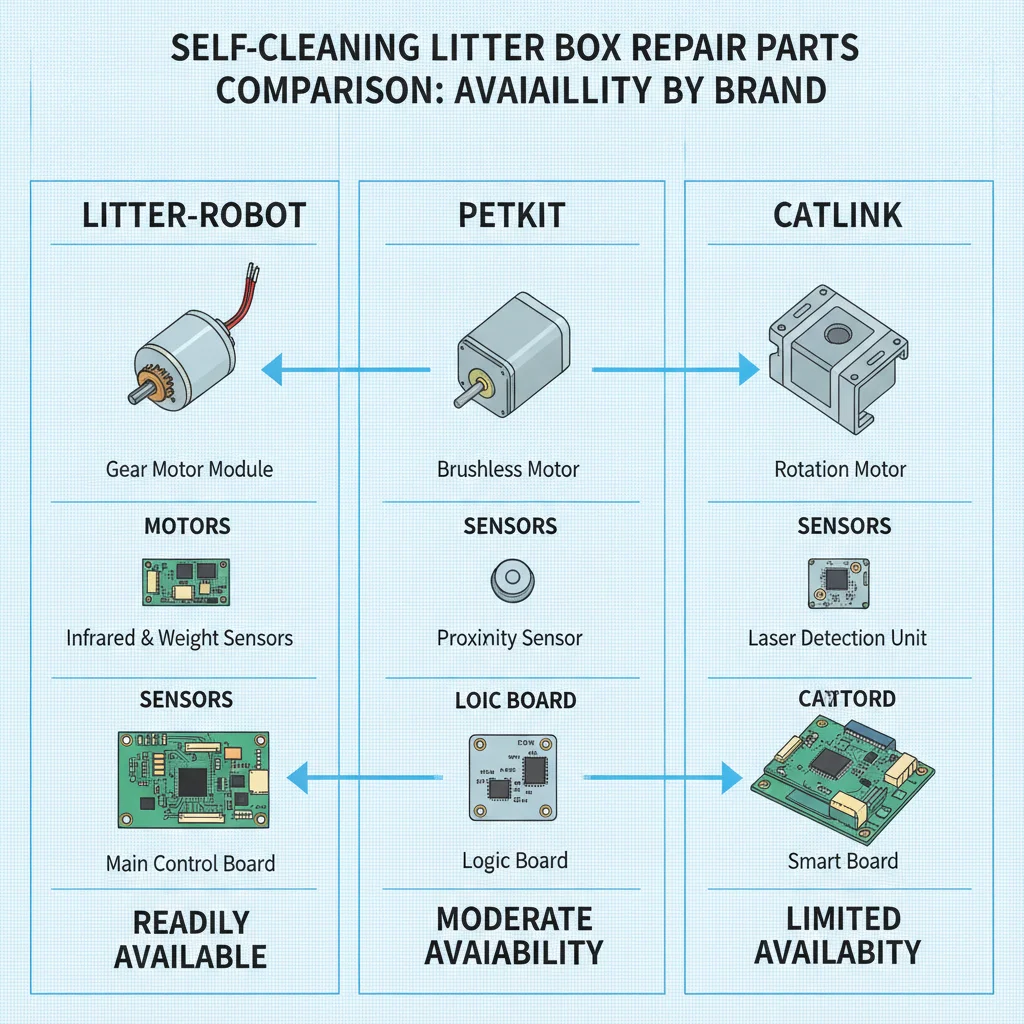
Brands with published parts catalogs age better than sealed disposable designs. Availability—not sticker price—decides whether you own a machine for four years or two.
Litter-Robot OEM parts catalog
Litter-Robot’s advantage for long-term owners is documentation plus a real parts path for many wear items. Globe seals, bonnets, drawers, and selected drive components show up in official catalogs more often than on no-name clones.
That does not make every repair cheap. It makes repair possible. Possibility is the difference between a $120 motor job and a $700 repurchase. Owners who buy primarily for fixability should confirm current SKUs for their exact generation before checkout.
- Match parts to your exact model generation (4 vs 5, etc.)
- Ask support which errors map to which replaceable assemblies
- Budget shipping time—days without a working unit matter in multi-cat homes
Petkit and Neakasa support paths
Petkit Pura X and Neakasa M1 compete hard on features and price. Repair ecosystems are more regional and less transparent than Litter-Robot’s mature catalog culture. Some modules are available through support tickets; others are “replace the unit” conversations.
Before you buy for a three-year horizon, email support with your country and ask for a parts list for motors, sensors, and boards. A brand that answers with SKUs ages better than a brand that answers with store links only. For feature trade-offs beyond repairability, see our Litter-Robot 5 vs Petkit Pura X vs Neakasa M1 comparison.
Third-party vs official repairs
Third-party shops and marketplace “compatible” parts can lower litter robot repair cost short term. They can also brick firmware, void remaining warranty, or fit poorly enough to create new sensor faults.
Use unofficial parts only when: the unit is out of warranty, OEM lead times are weeks, and you accept the risk of a second failure. Never bypass safety interlocks to “make it cycle anyway.”
Real repair and replacement cost table
Prices move by region and year, but the break-even pattern is stable. Use the table as a planning model, then confirm live quotes for your serial number.
| Repair type | Typical parts range | With shipping/labor | Replace instead when… |
|---|---|---|---|
| Drawer/globe motor or gear set | $80–$180 | $120–$280 | Quote > 40% of a quieter competitor you already want |
| Waste or cat sensor assembly | $40–$120 | $80–$200 | Part unavailable for your region/model |
| Control board / PSU | $120–$280 | $200–$450 | Unit already noisy/odorous and near end of life |
| Full base or major assembly | $250–$500+ | Often ≈ new mid-tier unit | Almost always—shop the market first |
Motor and sensor swap pricing
Motor jobs dominate the mid-tier litter robot repair cost conversations. Sensors are cheaper individually but recur if litter dust and depth issues are ignored. Fixing a sensor without fixing litter habits is renting the same failure.
Multi-cat households should assume higher annual wear. If you already need the heavy-duty capacity guidance in our best automatic litter box for multiple cats roundup, budget repairability into the shortlist—not just hopper size.
Shipping and labor estimates
Depot repair adds packaging, transit both ways, and downtime. Local technicians are rare for these SKUs. DIY saves labor but costs tools, risk, and time. A “$90 part” that needs three evenings and a second shipping label is not a $90 fix.
- Photograph serial labels and error screens before shipping
- Ask whether return shipping is prepaid
- Plan backup scooping for 7–14 days during depot work
When repair exceeds replacement value
A practical rule: if the all-in litter robot repair cost exceeds about 40% of a new unit you would happily own—especially a quieter apartment-friendly model—replace. Upgrading while fixing a chronic odor or noise complaint is often smarter than restoring a machine you already resent.
Apartment buyers should weigh noise and odor outcomes alongside parts math; see best self-cleaning litter box for apartments when repair quotes land in “maybe replace” territory.
Warranty vs out-of-warranty reality
Warranties reduce early litter robot repair cost to near zero when claims are approved. They do not erase maintenance obligations or cover every “it just stopped” story after heavy use.
What warranties actually cover
Expect coverage for manufacturing defects within the stated term. Do not expect free motors forever after abrasive litter abuse, liquid damage, or unauthorized board swaps. Read exclusions for consumables, misuse, and commercial multi-cat abuse clauses.
- Register the product early
- Keep litter-type and cleaning records if support asks
- Open a ticket at the first hard fault—not after months of resets
Extended warranty math
Extended plans only pay when failure probability × repair cost exceeds the plan price. For brands with scarce parts, an extended plan that still ends in “no part available” is worthless. Prefer manufacturers with SKUs over third-party paper promises.
DIY repair risks
DIY is reasonable for cleaning, recalibration, and user-replaceable modules with official guides. Opening sealed boards, cutting safety switches, or forcing cycles with a cat nearby is not. Injury and pet risk beat any litter robot repair cost savings.
Sensor and motor failures dominate long-term ownership complaints on Reddit—document them early so warranty and parts paths stay open.
Buy for repairability checklist
Shop repairability the same way you shop litter capacity. A $200 cheaper sealed unit that dies at month 18 can lose to a pricier modular design over three years.
Modular parts and documentation
Prefer brands that publish exploded diagrams, part numbers, and error-code maps. Ask support one pre-purchase question: “Which wear parts can I buy in my country for this exact model?” Vague answers are a signal.
- OEM parts catalog or clear support SKUs
- User-accessible filters, seals, and drawers
- Documented sensor reset / calibration flow
Community repair signals
Search owner forums for your exact model plus “motor,” “board,” and “sensor.” Healthy repair threads with part numbers beat marketing claims. Silence—or endless “just buy a new one”—is a warning.
Models that become e-waste
Budget clones without spare parts turn a $150 failure into landfill plus a full repurchase. If your household needs a machine for years, treat no-parts designs as disposable appliances, not investments. Brands with published parts catalogs age better than sealed disposable designs.
Also remember litter chemistry affects clogs and sensor fouling; pairing a fixable machine with compatible litter from best litter for Litter-Robot 2026 tests reduces how often you face litter robot repair cost decisions in the first place.
Before you buy, write down three numbers: expected cycles per day, a realistic parts budget for year two, and the price of the next-best unit you would actually switch to. If a sealed design cannot survive a mid-life motor or sensor failure without a full repurchase, treat the lower sticker price as a two-year lease—not a five-year investment. Premium only wins when parts, documentation, and support exist when you need them.
Finally, keep a simple ownership log: purchase date, litter type, major cleans, error codes, and any tickets. That log shortens warranty conversations and makes the repair-versus-replace call less emotional when a $200 quote lands in your inbox.
Frequently Asked Questions
How much does it cost to repair a Litter-Robot?
Common out-of-warranty repairs—drawer motors, waste sensors, and control boards—often run $80–$250 plus shipping when OEM parts are available. Full motor or base replacements can approach $300–$500, which is why many owners replace the unit instead of repairing after 18–24 months.
Can you buy replacement parts for automatic litter boxes?
Litter-Robot publishes many OEM parts; Petkit and Neakasa support varies by region. Budget clones often lack spare parts, turning a $150 failure into a full unit replacement. Check parts catalogs before buying any model you expect to run 3+ years.
Is it worth repairing a self-cleaning litter box?
Repair makes sense under warranty or when a $100–$150 part restores a $600+ unit with documented reliability. When parts are unavailable or labor exceeds 40% of a new competitor price, replacement usually wins—especially for apartment noise-sensitive buyers upgrading anyway.
What usually breaks first on auto litter boxes?
After 12–24 months of daily cycles, drawer or globe motors, waste-level sensors, and control boards top owner complaint lists. Litter type, multi-cat traffic, and skipped cleanings accelerate wear more than brand marketing admits.
Does warranty cover Litter-Robot motor and sensor failures?
Limited warranties typically cover manufacturing defects for a set period, not wear from misuse, litter damage, or skipped maintenance. Document error codes early, follow cleaning guidance, and confirm whether shipping both ways is included before assuming a free repair.
Related reading on our sister sites: Washable