Shoppers opening a pet camera night vision comparison are not ranking daytime 1080p samples. They want to know whether they can tell a dog from a shadow at 11 p.m., from a hallway or a dark living room, without walking downstairs. Spec sheets call every indoor cam “night vision.” After lights-out, those claims split into useful identification, a gray blob, or a blown-out white flare.
This is a low-light test of the three treat-camera shapes people actually buy: Furbo 360 on a shelf, Petcube Bites 2 as a wide fixed cone, and Enabot EBO rolling at floor height. For the full treat, app, and price scorecard, start with the Furbo vs Petcube vs Enabot 2026 comparison. For dispenser wear after a year, use the Furbo 360 long-term durability review.
This is owner-test video advice, not a veterinary protocol. A camera does not diagnose distress, seizures, or overnight collapse. If you are buying because a dog panics when you leave, pair hardware with a behavior plan and read whether treat cameras reduce barking before you treat night video as a substitute for training.
How we scored night vision (not spec sheets)
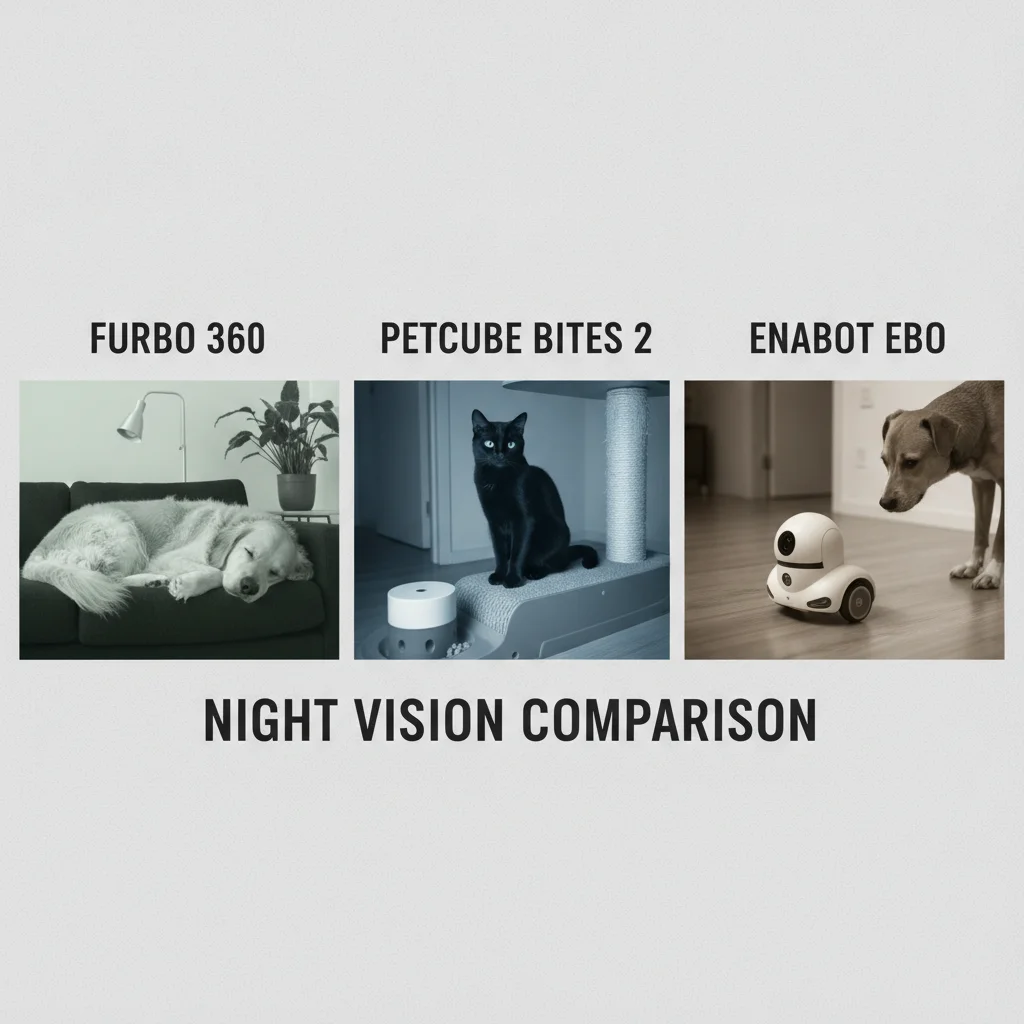
We scored stills and 15-second clips, not brochure language. Each camera sat in the same two rooms: a living room with blackout-capable blinds, and a hallway with a closed bedroom at the far end. Lights went fully off for the dark pass. A second pass used only streetlight leak through the blinds, because that is how most apartments actually look at midnight.
In a typical apartment living room with only streetlight through blinds, Furbo 360 still identified a medium dog on the sofa; Petcube Bites 2 did the same with more grain; Enabot needed to roll closer before the outline was obvious. That sentence is the whole ranking if you only remember one result.
The four stills that matter
Every camera got the same four jobs. Sofa distance in a dark living room. Close range at three feet, where IR bloom shows up. A hallway check from 12 to 15 feet. A moving-pet clip so smear and autofocus hunting could fail the camera even if the still looked fine.
We asked one question on each still: can you identify the animal without already knowing where it was? “Something moved” is not a pass. A laundry pile, a tossed blanket, and a dark-coated dog all produce motion. Identification is the welfare test.
- Pass: you can name the pet and see roughly what it is doing
- Soft fail: you see a body-shaped mass but not eyes, ears, or posture
- Hard fail: bloom, smear, or a hallway that looks like fog
What we refused to count as a win
We ignored daytime sharpness, treat-toss accuracy, and app beauty. Those matter; they are not this page. We also ignored color night stills shot with a hallway night-light still on. If the room is not dark, you are testing a cheap webcam, not IR.
Subscriptions were noted only when live view required a plan. On these three, live night video worked without paying. Cloud history did not. If your overnight job is peeking, test the free live path first.
Gear and rooms used
Furbo 360 sat on a 48-inch bookshelf, the height most people actually use. Petcube Bites 2 sat on the same shelf, then on a 60-inch cabinet, because the wider lens changes with height. Enabot started at the living-room doorway and rolled toward the sofa on hard floor, then on a low-pile rug that slowed it.
Wi-Fi was a typical dual-band home network, not a lab AP. If a clip stuttered, we re-ran it. Night vision that only looks good on 5 GHz one meter from the router is not a product. It is a demo.
What good night video actually means
A hallway night check from 12 to 15 feet is the real test: if you cannot tell a dog from a laundry pile, the camera is a motion toy, not a welfare tool. Marketing stills are usually shot at six feet with a light-coated dog facing the lens. Your 2 a.m. check is a dark coat, a curled shape, and a camera that has not been touched in a week.
Decide the job before you shop. Overnight crate watch, sofa watch, and “where did the cat go” are three different cameras. Mixing those jobs is how people buy a rolling bot and then complain it cannot see the whole room.
Identification versus motion blobs
Motion alerts are cheap. Identification is not. A passing car, a HVAC kick, and a tail all trip the same pixel change. If you cannot freeze a still and name the animal, you will open the app for noise until you mute it. Muted cameras do not help at 2 a.m.
Look at ears, spine line, and whether the animal is standing or collapsed. Those cues matter more than 2K badges. 1080p IR that holds an outline beats 2K that blooms into a white oval.
IR bloom, grain, and motion smear
IR bloom on a white or cream dog at three feet is not a defect unique to one brand; it is physics. You fix it with mounting height and angle, not with a more expensive SKU. Grain is the other tax: the sensor turns up gain in a sealed room, and the still looks like static. A little grain is normal. Grain that eats the outline is a fail.
Motion smear shows up when the pet walks and the stream is already starving for light. Rolling cameras add their own motion. A still of Enabot parked can look acceptable. The same camera rolling across a rug looks like a gray comet. Score the clip you will actually watch.
- Bloom: too much IR, usually too close
- Grain: not enough light, gain cranked
- Smear: subject or camera moving in the dark
Color night vision marketing vs IR reality
Treat-dispensing cameras in this set are infrared cameras that sometimes keep a hint of color if a streetlight or TV leftover is in the frame. That is not cinematic color night vision. Listings that show a full-color bedroom at “night” are usually showing a night-light, a window, or a different SKU.
Judge the dark pass. If the dark pass identifies the pet, color leftover is a bonus. If the listing will not show a true lights-out still, assume IR and shop the mount, not the hue.
Furbo 360 vs Petcube Bites 2 vs Enabot after lights-out
Fixed cameras win overnight overview. Rolling cameras win “go find them.” Mixing those jobs in one SKU is how people overpay and still walk downstairs. The table is the short version. The subsections are what the table cannot show: bloom, hallway reach, and whether you have to babysit the frame.
| Camera | Night mode | Dark-room ID at sofa distance | Hallway 12–15 ft | Best night job |
|---|---|---|---|---|
| Furbo 360 | IR + rotation | Strong if mounted high | Usable after a pan | Overnight room overview |
| Petcube Bites 2 | IR, wide fixed | Good, grainier | Better one-shot coverage | One-frame living room |
| Enabot EBO | IR, floor height | Weak until close | Poor until it rolls in | Scout / follow, not overview |
None of these is a security camera. They are pet gadgets with IR LEDs. Treat the scores as “can I skip walking in,” not as evidence for an insurance claim.
Furbo 360: rotation plus IR from a shelf
Furbo 360’s night advantage is not magic glass. It is the ability to re-center a dark room without climbing out of bed. From a 48-inch shelf, sofa-distance identification on a medium, mixed-coat dog was the most consistent of the three. Rotation also lets you check a crate in the corner, then pan back to the sofa, which a fixed wide lens only does if you aimed it perfectly on day one.
The failure mode is close-range bloom. If the dog sleeps under the camera, or you mount it on a side table aimed at a cream cushion, Furbo blows out faces like everyone else. Raise it. Angle down. Keep the rest spot in the middle of the frame, not under the lens. Treat tosses at night also throw a bright moving object through IR; do not score night video during a toss.
If you already own Furbo and night video looks like fog, clean the lens and check that a plant or lamp is not sitting in the IR path. Hardware age matters less here than a greasy fingerprint. For mechanical wear on the dispenser itself, that is the 14-month durability page, not this one.
Petcube Bites 2: wide angle, more grain, fewer lost dogs
Petcube Bites 2 does not pan. It buys coverage with a wide cone. In the dark living room, identification at sofa distance still passed, with more grain than Furbo and less need to hunt for the pet. That is the overnight personality: one honest frame, slightly uglier, fewer “where did they go” pans.
The hallway test is where the wide lens helps and hurts. You see more of the corridor in one shot. Edges stretch. A small dark dog at the far end can melt into baseboard. Height helps: the 60-inch cabinet beat the 48-inch shelf for hallway reach because you look over furniture instead of into it.
If your layout is one room and a short hall, Petcube is the least fussy night camera in this set. If you need to inspect two rooms, it is the wrong shape. Buy a second camera or pick rotation. Do not expect a wide lens in the living room to police a closed bedroom.
Enabot EBO: floor height wins only after it rolls in
Enabot’s camera lives near pet-eye height. That is a gift once it is three to six feet from the animal, and a liability for overview. From the doorway, lights-out, the sofa dog was a vague mass. After it rolled closer on hard floor, identification jumped. On rug, it arrived later and the clip smeared while it moved.
Do not buy Enabot as your only overnight camera if the job is “is the dog still on the bed.” Buy it if the job is “the cat vanished into the back hallway and I will not search in the dark.” Park it, then look. Driving while you watch is how smear and missed obstacles stack.
Floor IR also hates glossy tile. The illuminators bounce, and you get a bright floor with a dark pet. A mat in the usual path is a cheaper fix than a new camera. Stairs and thresholds still end the run; a rolling cam is not a second floor.
Distance, hallways, and more than one dog
Most listings are single-pet, single-room. Real night checks are two animals, a hallway, and a human who is already tired. If you have two dogs, start with the best pet camera for multiple dogs layout rules, then apply the night tests here. A camera that cannot separate two dark bodies in IR will spam you forever.
Distance is not a megapixel problem first. It is an illuminator problem. IR falls off fast. Fifteen feet in a narrow hall is harder than ten feet in an open living room even when the spec sheet lists the same range.
12–15 foot hallway check
Stand at the living-room end. Lights off. Pet at the bedroom door. If you cannot tell pet from pile, the camera is for the room it sits in, not for the house. Furbo passed after a pan that put the doorway in the center. Petcube passed in one frame with more grain and a softer far-end outline. Enabot failed until it drove the hall, which is a different product.
Long, L-shaped halls beat every consumer pet cam. You need a second unit or you walk. Do not fight geometry with a 2K upgrade.
Two dogs in one frame
Two similar dark coats in IR become one blob if they sleep touching. You will not reliably count heads. You will see that the sofa is occupied. If overnight counting matters—medication, a senior plus a puppy—put the camera where they separate at rest, or use two frames.
Treat tosses at night with two dogs are a separate mess: one IR flare, two animals colliding. Score night video with treats off. If the buying reason is barking loops, that is behavior plus audio, not a sharper night still.
Cats, small dogs, and dark coats
Small dark animals fail first. A black cat on a dark rug at twelve feet is the cruel test. All three cameras needed a closer mount or a closer roll. Furbo’s pan helps you search; it does not invent contrast. Petcube’s wide lens often includes the cat and still loses it in the noise. Enabot can win if it can navigate to the cat without knocking into furniture.
Cream and white coats fail the opposite way: bloom. Mount farther and higher. A side table aimed at a white dog’s face is the worst night setup you can buy on purpose.
- Dark + small + far: expect a miss unless you close the distance
- White + close: expect bloom unless you raise the camera
- Two touching bodies: expect a count of “occupied,” not “two”
Setup mistakes that wreck IR
Most “this camera has bad night vision” tickets are mounts. The SKU is innocent. If you can fix the still by moving the camera two feet, do that before you return it.
Mounting too close or too low
Three feet from a light-coated pet is a bloom machine. Coffee tables, sideboards aimed at a crate, and floor stands next to a bed all fail the same way. Go high, look across the room, put the rest spot in the middle third of the frame.
Too low has a second problem: you film furniture legs. IR lights the nearest object. A sofa arm in the foreground becomes a white wall, and the dog behind it disappears. If the preview is mostly upholstery, raise the camera.
Glass, mirrors, and glossy floors
A camera facing a TV, a picture glass, or a sliding door will photograph its own IR. You get orbs, streaks, and a pet that looks like a ghost behind glare. Angle off the glass. At night, turn the TV off for the test still so you know what the camera does without a giant light box in the scene.
Glossy tile at floor height is Enabot’s tax. Fixed cameras on a shelf mostly avoid it. If the only good outlet is opposite a mirror, pick a different outlet.
Leaving a lamp that fools the sensor
A dim lamp across the room can keep the camera in a muddy color mode instead of committing to IR. The still looks yellow-brown and underexposed. For a true night check, kill the lamp. If you always sleep with a night-light, test with that light, because that is your real mode—but do not compare that still to a competitor’s true-dark still.
Auto night switching can lag. Walk away, wait a minute, then open live view. Scoring the first two seconds after you hit the wall switch is how people call a camera “slow” when the sensor is doing its job.
Who should buy which for overnight monitoring
Buy the shape that matches the room, then accept the IR limits. Do not buy a rolling robot because it looks advanced and then expect a stable crib-watch frame. Do not buy a wide fixed camera for a three-room ranch and then blame night vision.
Default pick by room layout
One main room, pet sleeps on a sofa or in a visible crate: Petcube Bites 2 if you want set-and-forget framing, Furbo 360 if you want to peek at a second corner without a second device. Long sightline plus a doorway you care about: Furbo, because you can pan the door into center. Pet who vanishes into other rooms: Enabot as a scout, plus a fixed camera on the actual sleep spot.
Two-story homes do not get solved by one gadget. Put a fixed camera where the animal sleeps. Use stairs as a hard stop for rolling units. Multi-dog households should read the multiple-dog guide for placement before they chase a night-vision SKU.
- Furbo 360: best overnight overview when you will actually use rotation
- Petcube Bites 2: best one-frame living room, slightly noisier stills
- Enabot EBO: best finder, worst parked overview
When night video is not the buying reason
If the pain is separation barking, night stills will not fix it. Watch the barking test page and treat video as a check, not a cure. If the pain is dispenser jams, night vision is a side quest. If the pain is “I travel and need two-way audio more than IR,” test talk-back in a quiet room; compression artifacts at night are a separate annoyance.
Anxiety-focused shoppers should still start with the separation-anxiety camera guide and only use this page to reject a camera that cannot identify the pet in the dark. A soothing voice in a gray blob is not monitoring.
Privacy after you leave the night stream running
Overnight cameras are always-on microphones and lenses in the room where you sleep or change. That is a household decision, not a spec row. Before you leave a night stream running for months, read pet camera privacy risks and lock the account, the network, and physical lens habits.
Night IR also means the camera can see when you think the room is private because it is dark. Point it at the pet zone, not the bed you share. Disable unused cloud clips if you only needed live peek. A night camera you forget is still a camera.
Frequently Asked Questions
Which pet camera has the best night vision in 2026?
For a typical living room from a shelf or counter, Furbo 360 was the most useful overnight overview because rotation lets you re-frame without walking in. Petcube Bites 2 was close on identification at sofa distance and often easier if you want one wide shot and no panning. Enabot EBO is not the overnight overview winner; it is the follow-the-pet tool once it can roll closer.
Is infrared night vision better than color night vision on pet cameras?
For most treat cameras in 2026, infrared is what you actually get after lights-out. Color night vision needs leftover ambient light or a dedicated illuminator and still fails in a sealed bedroom. Judge the camera on whether you can identify the animal, not on a daytime color sample. If a listing leans on color night stills, check whether those stills were shot with a night-light still on.
Why does my pet camera look washed out at night?
IR bloom. The illuminators sit next to the lens. A white dog, a close mount, or a reflective floor dumps light back into the sensor and erases eyes, muzzle, and coat. Raise the camera, angle it down across the room, and keep the pet’s usual rest spot outside the three-foot blast zone. Buying a different brand rarely fixes a three-foot mount aimed at a cream sofa.
Can a rolling camera like Enabot replace a fixed night camera?
Only if your job is finding the pet in another room and you accept smear while it moves. A rolling camera at floor height does not give you a stable overnight overview of a crate, sofa, or baby gate. Use Enabot as a scout. Keep a fixed camera for the place the animal actually sleeps.
Do I need a subscription to use pet camera night vision?
Live night video usually works without a plan. Cloud clips, smart alerts, and longer history are where subscriptions show up. If your overnight use is peeking at a live stream, test that path before you pay. If you need saved 2 a.m. clips, budget the plan as part of the camera, not as an optional extra.
Your next step
Mount the camera high, kill the lights, and run the sofa still plus the hallway still before you keep the box. If identification fails, move the mount before you switch brands. If identification passes, stop shopping night vision and decide on treats, app noise, and privacy instead.
Use the head-to-head 2026 comparison for the rest of the scorecard. Come back to this page when a listing’s “full-color night” screenshot does not match the dark room you actually have.
Related reading on our sister sites: Petlibro