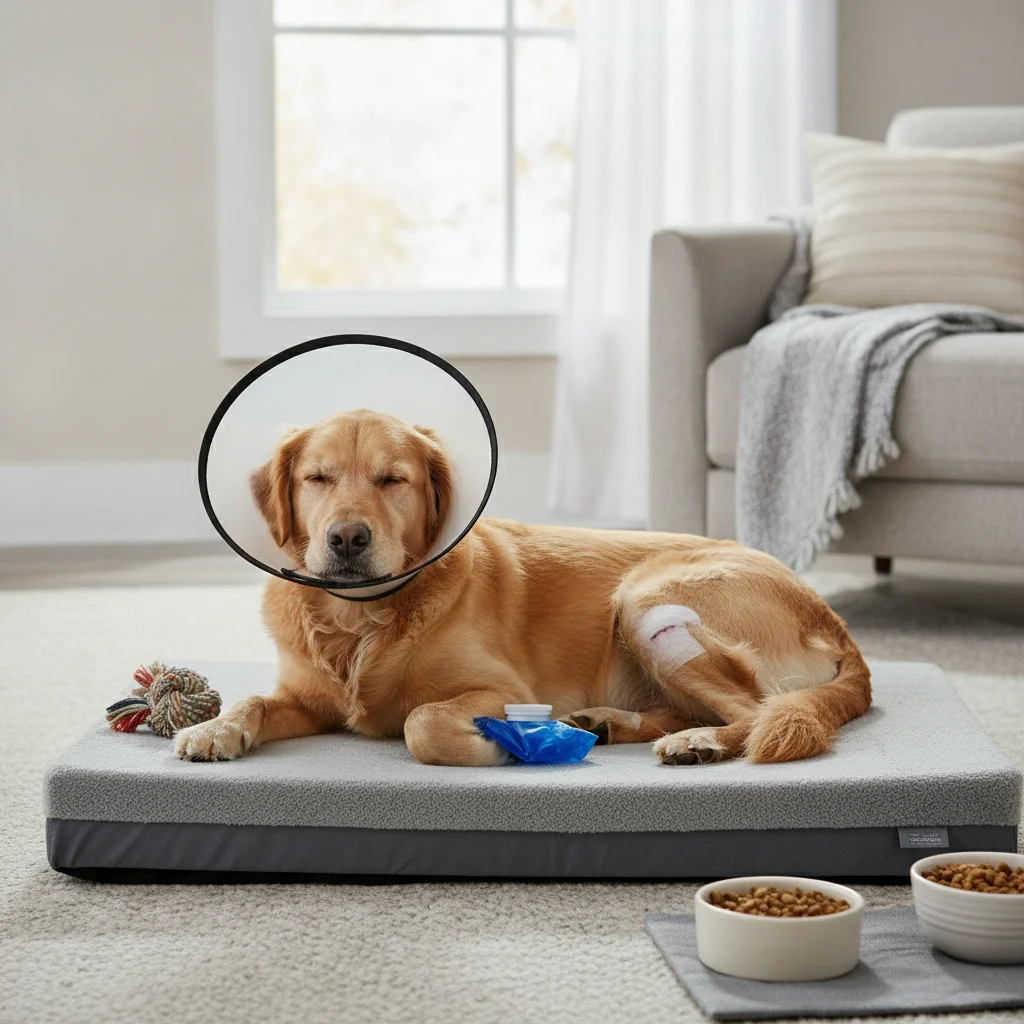
The best dog bed after tplo surgery is a low, firm, washable pad that fills the crate floor so the dog steps on rather than climbs. Skip deep doughnut beds and sofa-style walls until your surgeon clears jumping. If the dog is already back to stairs and off-leash play, this page is the wrong shopping list; buy a long-term orthopedic instead.
The American College of Veterinary Surgeons says TPLO requires several weeks of confinement while the bone heals. MedVet’s home-recovery guide adds no jumping, running or stairs until recovery is well advanced. The bed is only the surface inside that plan.
For foam types after clearance, see memory foam vs hybrid vs gel. For arthritis later, see the senior orthopedic guide.
What the surgeon’s crate actually needs
ACVS describes TPLO as a semicircular cut in the tibial plateau, held with a plate and screws, with confinement required to prevent implant and bone complications. MedVet tells owners to keep the dog in a crate or small room, on a leash for bathroom breaks only, and to treat running, jumping, playing, and stairs as restricted until follow-up says otherwise.
That list sets the bed spec:
- Entry height the dog can walk onto in a cone, without a hop.
- Foam firm enough to push up from on three legs; shredded fill collapses under a single shoulder.
- A washable cover, because pain meds, incision seepage, and accidents are expected.
- A base that does not slide on tile when the dog lies down.
Dog Orthopedic’s surgery-bed guide puts the same three properties in that order: solid foam, open low entry, washable cover over a waterproof liner. Decorative bolsters fail the second item during weeks of crate rest.
Recovery length is not a shopping number. Southwest Veterinary Surgery keeps strict confinement in place until follow-up X-rays show the bone has healed. Photograph the setup and take it to the recheck rather than copying a timeline from a listing.
Low pads vs bolster sofas
A sofa-style bed with three raised walls is a climb. After TPLO, MedVet rules out jumping until recovery is well advanced. A rim that looks like a pillow is still a hurdle in an E-collar.
Use a rectangular pad in the crate for the restricted phase. After the surgeon clears more room time, a low orthopedic with one open side is the next step. Keep the same sleep height in crate and living room during the transition so the dog is not practicing a jump the protocol still bans.
Place food, water, and the bed on one level. MedVet rules out stairs, and one level means no carrying a groggy dog up to bed. Non-slip rugs under the pad matter as much as foam: a supportive surface that slides when the dog sits is a fall risk on three legs.
Do not park the crate beside a sofa. Dog Orthopedic notes that a bed next to a couch invites the one jump that undoes the restriction. Keep other pets off the recovery pad so the surgical leg is not bumped in sleep.
Beds that match crate rest
| Product | Price (Oct 2026) | Height / foam | Why it fits TPLO crate rest | Skip if |
|---|---|---|---|---|
| K9 Ballistics Tough Ripstop Orthopedic Crate Bed | $100 on k9ballistics.com | 2 in (S) to 4 in (XL/XXL); dense solid foam; 10-year won’t-flatten warranty on the mattress | Corner tie-downs on wire crates; removable cover and liner; sizes mapped to crate footprints | The dog is a heavy chewer (maker says foam can obstruct if eaten) |
| Big Barker OrthoLift Crate Bed | From $109.95 on bigbarker.com | Listed as a crate mattress in the same line as the 7 in Original; CertiPUR-US foam on the Original | Crate-shaped, no sofa walls; same brand as the 7 in bed used after clearance | The crate has little headroom (a 4 in pad takes up height) |
| Big Barker Original (Sleek) | From $249.95 | 7 in, 2+3+2 in layers; 10-year no-flatten (foam keeps ≥90% support); 180-night trial | Open, flat profile after the dog is allowed more room time | You still need a crate-only pad this week; $249 is over budget for an 8-week interim |
Sources: K9 Ballistics Tough Ripstop Orthopedic, Big Barker bed list, Big Barker Original specs and warranty, Dog Orthopedic surgery-bed criteria.
A 4 in foam crate pad reduces headroom. Confirm crate interior height with a tape before you order. Size the pad so the dog can stand, turn, and lie down; Confinement is a controlled space, not a runway.
Crate size, floors, and the E-collar
MedVet’s aftercare: pets belong in a crate or small room so unsupervised running cannot load the repair. The bed must fit that box. An oversized crate lets a dog generate speed and stop hard; an undersized pad plus a cone means the incision hits the door.
Wire floors are a slip hazard. If the crate has a grate, add a solid tray or a tied-down pad. K9 Ballistics documents zip-tie anchors at each corner for wire crates only; the maker says the pad can compress 0.5–1 in to squeeze a slightly smaller crate, and that the tie-down does not work on plastic airlines.
Test entry with the collar the clinic issued. Clinics commonly issue an Elizabethan collar or a recovery suit; either changes how a dog aims for the pad. Washable covers are practical because bathing is restricted until the incision is cleared.
Keep the route from pad to door short and dry. A soaked bed is a problem around an incision. If the dog is incontinent on opioids, a waterproof liner under a washable cover is the spec, not a plush nest.
After clearance, and when $250 is the cheaper path
Once radiographs and the surgeon allow more activity, the job of the bed changes from “do not climb” to “do not bottom out for years.” Big Barker’s Original lists a University of Pennsylvania veterinary study on large dogs (less pain and stiffness in the company’s write-up of that study), 7 in of layered foam, and a 10-year no-flatten warranty if foam drops below 90% support. That is a different purchase from a $100 crate pad.
Stage it: crate pad for the restricted weeks, then a long-term orthopedic if the dog still sinks or if the other knee is at risk. ACVS reports that 40–60% of dogs with cruciate disease in one knee later have the same problem in the other, often within 12–18 months. A bed that already failed the fist test is a poor place to start the second recovery.
Budget after clearance is covered in the under-$150 orthopedic guide. Skip budget egg-crate foam for a Labrador-class dog; neither K9 Ballistics nor Big Barker publishes density in lb/ft³, so thickness, weight rating, and warranty are the comparable numbers.
Ask your surgeon about physical rehabilitation, and do range-of-motion work and leash walks as prescribed. Leave clear floor around the pad for sit-to-stand homework. The bed does not replace that work.
Buy the pad the crate and the cone can use this week. Upgrade foam after the surgeon, not after an Amazon photo.
Frequently Asked Questions
What bed should a dog use right after TPLO?
A low, firm, washable crate pad with a non-slip base, sized so the dog can stand and turn. Avoid deep bolsters until jumping is allowed. Confirm crate dimensions with your surgeon.
Do vets require crate rest after TPLO?
ACVS says TPLO needs several weeks of confinement while bone heals, and MedVet’s guidance is a crate or small room with leash-only bathroom breaks unless the team directs otherwise. Follow the discharge sheet, not a generic week count.
How firm should the recovery bed be?
Firm enough that the surgical hip or shoulder does not sink and the dog can push up. Dog Orthopedic’s rule is a solid foam slab, never shredded fill. If the surface rocks when the dog stands, it is too soft for this phase.
When can the dog use stairs and a bolster bed again?
When the surgical team increases activity after rechecks. Keep a stable pad on the sleeping level even after stairs return.
Is a $250 orthopedic necessary during crate weeks?
Not if a $100 solid-foam crate pad fits and the dog can step on it. Spend the larger sum after clearance if you want 7 in foam and a 10-year flatten warranty, or if the dog is already a large arthritic patient.