A year of lobby marble, curb cuts, and twice-daily folds is the real pet stroller after one year durability test. The first failure is almost never the mesh cabin; it is a wobbling front hub, a sticky latch, or an axle clip that no longer seats.
This log is a 12-month wear protocol for city frames, not a first-purchase size chart. Specs and prices cited are as of 14 November 2026. Owner reports from retailer pages are labeled as such; they are not a lab failure rate.
A senior dog who rides to the clinic still needs a crate that lasts as long as the chassis. Compare that timeline with a heavy-duty crate after 12–18 months before you treat either product as disposable.
Year-one protocol: elevators, vet trips, and stair carries
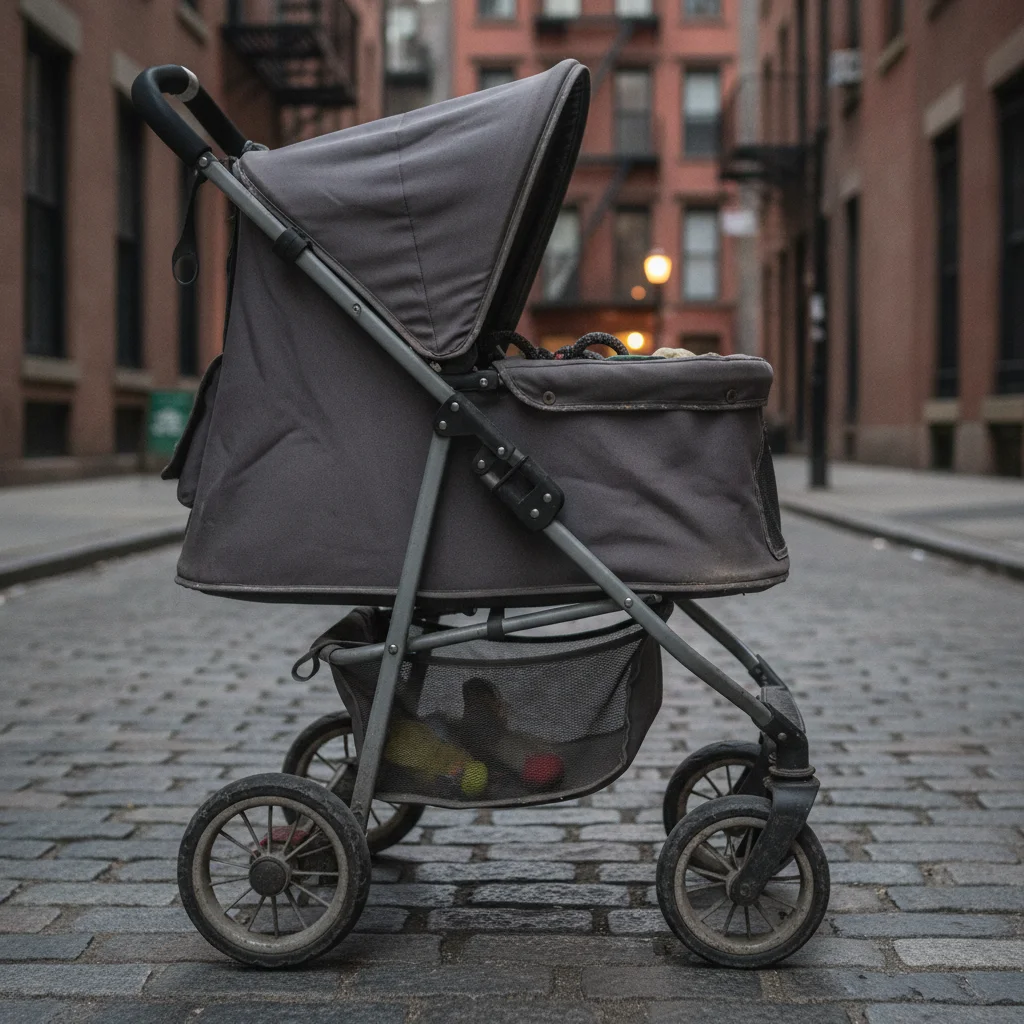
Log three numbers every month: lateral play at the front hub, force needed to close the fold latch, and how many times you lift the empty frame onto a stair landing. Those three predict retirement better than star ratings.
The U.S. Access Board elevator guide restates 2010 ADA §407.4.1: 36-inch clear openings for off-center doors, 42 inches when the door is centered. Existing residential cabs can be tighter. Measure yours with the door closed before you blame the stroller for scraping side rails.
Vet mornings compress the same fold you do in the lobby. If the latch needs two hands and a hip, you will skip it when the cab is closing, and that is how plastic releases crack.
Wheel and axle failures after 12 months of city use
Monthly wheel inspection
Park the stroller, lock the rear brake, and spin each wheel by hand. Listen for grit, then grip the tire and rock it left-right. More than a few millimeters of play at month three is a worn bushing, not “normal break-in.”
Pet Gear’s Happy Trails PG8100NZ manual tells you to keep axles and swivels clean, use WD-40 or light machine oil on moving parts, and never oil the brakes or swivel locks. Wipe salted slush off the forks the same day you roll through it.
- Mark the month you first hear a squeal; oil once, then re-check in seven days.
- Photograph the hub clip from both sides so you can see oval wear later.
- If a wheel walks off the axle under a light pull, stop using the frame on streets.
Fold cycle logging
Count folds, not miles. Two elevator trips a day is about 60 cycles a month, 700-plus in a year. Travel strollers are designed around airport days, not that cadence.
Write down whether the safety button or side latch still snaps without a slap. A latch that needs a slap at month four will need a hammer by month ten, which is how housings split.
Practice the empty fold in the vestibule. A dog still in the cabin is never a fold; every Pet Gear PDF says remove the pet and empty the basket first.
Fold mechanisms after a year of elevators
Transit stair carries
When the elevator is down, you lift empty weight plus dog plus whatever is in the basket. Speedy Fold-class frames around 13 lb stay a one-person carry with a 20 lb dog. Expedition-class 26 lb empties plus a 40 lb dog become a two-person job.
Happy Trails, Expedition, and Promenade manuals all say fold the chassis and carry it on stairs rather than rolling a loaded cabin. None of those PDFs give a lift rating for a dog still in the basket. Do not invent one.
- Never roll a cabin down subway stairs; lock the brake, fold, and carry.
- If you cannot lift the empty chassis to chest height twice, that model is a ground-floor tool.
- Keep a harness tether clipped even during a carry so a startled dog cannot bail onto the landing.
Subway stairs and station carries
Month 1–3: first wobble and fold stiffness
The first quarter is when cheap bearings announce themselves and when plastic latches polish to a slick, then stick. Curb clips that will die later already sit slightly proud.
Cheap bearing noise
A dry plastic-on-steel squeal at week six is usually grit, not a dead race. Oil once, wipe the fork, and roll 50 lobby lengths. If the pitch returns immediately, the hub is already oval.
Amazon 3-wheel listings in the $35–60 class often use a single hollow front stem. Owner clusters on those product pages describe a clip shearing on the first curb. Treat that as a first-quarter kill, not a year-one wear-out.
Gen7Pets’ Promenade care sheet (Chewy PDF) says apply light household oil for squeaky wheels and check for loose parts. That is the month-one habit that keeps a $280 frame from sounding like a $40 fork.
Latch polish
New plastic latches feel tight. After 80–100 folds they glaze. Glaze plus winter salt equals a latch that will not seat unless you look at it.
Happy Trails still needs canopy open, Velcro flaps free, then a slide-and-rotate handle lock. That sequence does not get shorter with practice; it only gets faster if you stop adding extra hip pressure.
If the Promenade Smart-Fold lever starts to travel farther before it catches, stop folding from the handle in a moving cab. A half-latched aluminum frame pinches paws on the threshold.
Curb damage
Four-inch curb cuts load the front assembly sideways if the swivel is unlocked. Lock swivels before a bump; unlock them in the lobby.
Dkeli-class Amazon 3-wheels list about 34 × 17.5 × 39 in open and a 35 lb pet cap. Their folded pack is still thick on one axis, so they do not “win” elevators just because they are cheap.
A nicked EVA tire is cosmetic. A cracked hub flange is retirement. Photograph both after the first hard curb so you can tell which one you have at month six.
Month 4–8: axle play and hardware fatigue
Mid-year is when cotter pins walk, rivets elongate, and brake cables stretch so the pedal no longer bites on a slope. This is also when named spare wheels still exist, if they ever will.
Replacement wheels
Pet Gear’s Happy Trails manual: rear wheels come off with a locking lever under the housing; use only Pet Gear parts; have the model number ready; call 877-752-9123 or request parts on petgearinc.com. That path is why a $130 No-Zip is cheaper to keep than a $40 fork you cannot match.
Gen7Pets assembly diagrams split dual front wheel, rear axle, and rear wheels as separate pieces. Petmate’s Promenade retail card does not list a public wheel SKU; you still have Petmate consumer services and customerservice@gen7pets.com as named desks.
Ibiyaya Speedy Fold retailer copy advertises quick-release wheels. Confirm a US parts email before you assume a 13 lb umbrella frame is serviceable at month eight.
- Order a wheel set when play exceeds 5 mm, not after the tire walks off in traffic.
- Keep the original hub cap; no-name replacements often omit the retention geometry.
- If the brand has no model number on the frame sticker, do not budget a repair.
Frame rivets
Look at the joints where the handle meets the side rails. Elongated holes show as shiny aluminum around a dull rivet. That is fatigue, not dirt.
Umbrella frames flex when you hoist 30 lb in the cabin onto a curb. Pet Gear’s Happy Trails PDF caps the pet at 35 lb even when some tiles say 30 lb. Believe the number printed in the manual you can still download.
If a rivet head is proud on one side and flush on the other, retire the stroller. Drill-and-bolt repairs on thin tubing fail the next elevator threshold.
Brake cable stretch
Kick the rear brake on a gentle garage ramp. If the stroller creeps, the cable has stretched or the pad has glazed. Do not compensate by hanging a grocery bag on the handle; Pet Gear manuals warn that hanging bags make the chassis unstable.
Oil never belongs on the brake. If a pedal feels mushy after lubrication, you contaminated the only thing holding the frame on a subway platform.
A parking brake that holds on linoleum but not on wet brick is already past mid-life. Budget a cable if the brand sells one; otherwise treat the stroller as indoor-only.
Month 9–12: retire signs and total cost of ownership
By month nine you know whether you own a serviceable chassis or a seasonal toy. Irreparable folds, discontinued hubs, and a heavier wagon math decide the last quarter.
| Month window | Typical first symptom | Fix if parts exist | Walk-away cue |
|---|---|---|---|
| 1–3 | Squeal, sticky new latch, curb nick | Clean, oil swivels, photograph hubs | Front clip shears or wheel walks off |
| 4–8 | 5 mm+ hub play, mushy brake, rivet shine | OEM wheel or cable; named parts desk | No model number, no matching hub |
| 9–12 | Latch needs a slap, oval EVA, cracked release | Replace latch only if brand still molds it | Fold will not lock; fabric torn at stress points |
Add purchase price plus one wheel kit plus your time. A $40 frame that dies at week two and a $130 frame that takes one $25 wheel at month ten are not the same cost per elevator trip.
Irreparable folds
A cracked plastic release housing cannot be zip-tied safely. The fold is a structural lock, not a cosmetic clip. If the Promenade lever or Happy Trails slide no longer shows a positive lock, the year is over.
Canopy fabric tearing at the corner is repairable with a patch. A split latch tower is not. Do not ride a half-latched frame into a closing cab door.
Vet-trip fold reliability under time pressure is the same latch you logged at month two. If it failed you twice on a Monday morning, buy the next chassis before the next blood-draw appointment.
Parts discontinued
Pet Gear’s written warranty covers manufacturing defects for 30 days from purchase for the original buyer, with proof of receipt, and excludes animal damage, misuse, and non-Pet Gear accessories. Wheel wear at month eleven is outside that window. The value is the parts desk, not the 30-day clock.
Petmate’s FAQ says warranties apply only on select products and only when bought from Petmate or an authorized dealer. Marketplace “open box” Promenades can be orphaned even if the metal still looks new.
No-name 3-wheels almost never have a matching front fork a year later. Color-matched “universal” wheels from a third-party listing will not share the clip geometry.
When to switch to wagon
Switch when the dog is honestly over the cabin rating, cannot be lifted onto a landing, or needs a side-load after surgery. Pet Gear Expedition No-Zip (PG8800 class) lists a 150 lb pet cap in its PDF at about 26 lb empty and a wide body. Ibiyaya Noah All-Around Beach Wagon FS2130 lists 110 lb / 50 kg at about 37.5 lb empty and ~27 in overall width.
Those wagons lose 1960s apartment cabs. They win ground-floor doors and park paths. Do not use a 110 lb rating as permission to skip the tether.
If you still need a cabin that folds under 10 in on one axis, stay on Speedy Fold-class umbrellas and accept a lower pet cap. A wagon that will not enter the elevator is not a durability upgrade.
Brand patterns: Gen7Pets, Pet Gear, Ibiyaya, budget 3-wheels
City-ownership wear sorts brands by parts desks and latch geometry, not by “best overall” badges. Survivors share a model number you can read on the frame at month twelve.
Survivors
Pet Gear Happy Trails No-Zip PG8100NZ: 35 lb in the manual, US parts line, cotter-style rear removal, and a documented oiling ritual. It survives a year when you stay under the printed cap and stop hanging bags on the handle.
Gen7Pets Promenade G2340: 50 lb rating, ~20 in published width, dual front wheel that can be oiled, Smart-Fold from the handle. It survives when the dog actually fits the 13-inch-wide cabin and you check the rear axle pins.
Ibiyaya Speedy Fold FS1670: 44 lb / 20 kg, 13 lb empty, folded pack 17 × 9 × 23 in on dealer cards. It survives elevator duty because you can carry it like a tall tote instead of wrestling a 22-inch body.
- Survivor test: can you still name a phone or email that will sell a wheel?
- Survivor test: does the fold lock without a slap after 700 cycles?
- Survivor test: does the brake still hold on wet brick?
Early deaths
Budget 3-wheel dog stroller lifespan in this city context is often measured in curbs, not years. The Dkeli-style Amazon frame around $39.76 with a 35 lb tile is a reasonable experiment only if you accept a disposable front stem.
That listing’s durability comments include wheels coming off in days and clips breaking on first use. Those are owner quotes on the product page, not a percentage we measured.
Marketplace clones that drop the model number from the title are early deaths by definition: you cannot order a hub for a name that no longer exists.
Warranty reality
Thirty days of defect coverage does not equal twelve months of rolling stock. Pet Gear will replace a defective part inside the window; it will not rewrite physics for EVA hubs on brick.
Keep the receipt, the frame sticker, and a dated photo of the first wobble. Warranty desks ask for those three things; Amazon chat transcripts do not substitute for a model number.
Unauthorized marketplace sellers can void Petmate support even on a genuine Promenade. If year-one durability is the job, buy where the brand still answers email.
Checklist before your next city stroller buy
Shop the failure modes you just logged, not a “best 2026” stack. Elevator footprint, bearing access, and latch material decide whether month twelve is a repair or a trash bag.
Bearing access
You need a wheel you can pull without grinding a rivet. Pet Gear’s lever-release rears are the teaching example. Press-fit plastic caps with no documented lever are a one-way part.
Ask the seller for the wheel SKU before you click buy. Silence is an answer: you are buying a sealed toy.
Solid EVA is the right city compound because glass does not flatten it. The failure you are inspecting is the axle clip, not the foam.
Fold latch material
Metal-on-metal handle levers (Promenade Smart-Fold class) tolerate lobby haste better than multi-step Velcro-plus-slide dances. Plastic towers that take a slap will crack on the 400th elevator chime.
Confirm the lock indicator is visible from the side you stand on in a crowded cab. A latch you cannot see is a latch you will trust too soon.
Pair the fold with a front-door dog gate setup so the dog cannot dash while both of your hands are on the chassis.
Elevator footprint
Keep published overall width at or under 20 inches if you share cabs with carts. Folded thickness under 10 inches is what lets you stand the pack on end.
Ibiyaya Elegant Retro-class frames can stay ~23 in wide even folded. That is a full-size cabin in a small elevator, not a compact.
Measure the door, then measure the dog’s chest. A 50 lb rating on a 13-inch cabin is a structural ceiling, not a comfort promise for a barrel-chested mix.
Street prices shift weekly. Confirm the PG8100NZ, Promenade G2340, and FS1670 cards still print a model number the day you order. A listing that hides the SKU is not a year-one parts plan.
Frequently Asked Questions
What usually breaks first on a city dog stroller?
The front hub and axle clip, then the fold latch. Mesh and canopies tear later. Log lateral play monthly; if a wheel walks off under a light pull, stop using the stroller on streets.
Does Pet Gear’s warranty cover a wobbly wheel at month eleven?
Usually no. Pet Gear’s published limited warranty is 30 days against manufacturing defects for the original buyer with proof of purchase. Wear, animal damage, and non-Pet Gear parts are excluded. The 877-752-9123 parts desk still matters after the clock runs out.
How many folds is a year of apartment elevators?
Two round-trips a day is about 60 folds a month, more than 700 a year, plus vet sprints. Travel-oriented umbrellas are not designed around that cadence unless the latch still locks without a slap.
When should I replace instead of repairing?
Replace when the fold will not lock, the brand has no matching hub, or the brake will not hold on wet brick. A $25 OEM wheel at month ten is a repair. A cracked latch tower is not.
When is a wagon the better year-two tool?
When the dog exceeds the cabin rating, cannot be lifted onto a landing, or needs a side-load. Expedition- and Noah-class wagons hold more weight but lose narrow cabs; they are not a stealth upgrade for 36-inch doors you already scrape.